

Characterization of clinical-epidemiological factors in the incidence of leprosy
Abstract
Introduction: The global goal for the elimination of leprosy is its early detection, which requires a comprehensive approach, knowing the various factors that can favor its acquisition, to develop strategies that contribute to its eradication.
Objective: To characterize the clinical-epidemiological factors in the incidence of leprosy in the Camagüey municipality.
Methods: A retrospective cross-sectional descriptive observational study was carried out, whose work universe consisted of all the patients with a diagnosis of leprosy in the Camagüey municipality, during the studied period. The variables studied were: clinical forms according to Madrid classification, age, sex, first symptoms and signs, location of the lesions, bacilloscopy, mode of detection, source of infection, and situation of the patient about the focus. The information obtained was processed using the statistical package SPSS v21. The methods used were descriptive statistics of the distribution of absolute and relative frequencies. The results of the study were presented in tables and graphs.
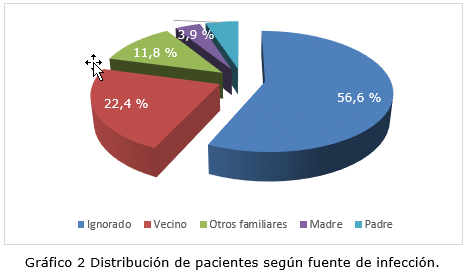
Results: Dimorphic leprosy was the one with the highest incidence, the age group between 60 and older prevailed with a predominance of males, more than half of the patients presented anesthetic spots as the first symptom, and smear coding was zero. The most relevant detection mode was spontaneous, the source of infection was ignored, and the index case prevailed in the patient's situation in relation to the outbreak.
Conclusions: The results of this study show that it is necessary to increase the training of health personnel and deepen the search for cases.
DeCS: MYCOBACTERIUM LEPRAE/epidemiology; DISEASE TRANSMISSION, INFECTIOUS; CONTACT TRACING; RISK FACTORS; FOCAL INFECTION.
Downloads
References
1. Ramos-e-Silva M, Ribeiro de Castro MC. Infecciones micobacterianas. En: Bolognia JL, Shaffer JV, Cerroni L, editor. Dermatology. 4ta ed. España: Elsevier; 2018. p 1296-1318.
2. Kezhaleto Z, Sharma PK, Bhardwaj M. Evaluación histopatológica e inmunohistoquímica de piel con y sin lesiones en lepra borderline: Estudio en 50 pacientes. Fontilles Rev Leprol [Internet]. 2019 [citado 14 Oct 2020];32(2):105-120. Disponible en:
https://www.leprosy-information.org/media/845/download
3. Colectivo de autores. Lepra. Normas técnicas para el control y tratamiento. La Habana: Editorial Ciencias Médicas; 2008.
4. Osorio Illas I, Ambos Frutos I, Viches Lescaille DC, Agüero Román L, Sibila González ME, González Díaz RE. Lepra ocular a propósito de un caso. Fontilles Rev leprol [Internet]. 2019 May-Ago [citado 14 Oct 2020];32(2):75-85. Disponible en: https://www.leprosy-information.org/media/845/download
5. Govindan A, Sasidharanpillai S, Ajithkumar K, Puthen Parambath S, Abdul Latheel EN, Rahima S, et al. Inmunohistoquímicas de las lesiones cutáneas en la lepra y las leproreacciones. Fontilles Rev leprol [Internet]. 2018 Sep-Dic [citado 14 Oct 2020];31(6):443-66. Disponible en: https://pesquisa.bvsalud.org/portal/resource/pt/ibc-178459
6. van Hooij A, van den Eeden S, Richardus R, Wilson L, Franke KLMC, Faber R, et al. Identificación de biomarcadores para aplicar métodos inmunodiagnósticos para la detección precoz de lepra en el campo. Fontilles Rev leprol [Internet]. 2019 [citado 14 Oct 2020];32(3):186-87. Disponible en: https://www.leprosy-information.org/media/920/download
7. Lenz SM, Hunter Collins J, Ray NA, Deming AT, Lahiri R, Adams LB. Eficacia de distintas pautas quimioprofilácticas en un modelo subclínico susceptible de lepra. Fontilles Rev leprol [Internet]. 2019 [citado 14 Oct 2020];32(3):184-85. Disponible en: https://www.leprosy-information.org/media/920/download
8. Acosta Soto L. Cero transmisión, cero discapacidad y cero discriminación. Fontilles Rev leprol [Internet]. 2019 [citado 14 Oct 2020];32(3):153. Disponible en: https://www.leprosy-information.org/media/920/download
9. Torres P. 20o Congreso Internacional de Leprología: Manila, Filipinas. Fontilles Rev leprol [Internet]. 2019 May-Ago [citado 14 Oct 2020];32(2):65. Disponible en: https://www.leprosy-information.org/media/845/download
10. Rumbaud R, Aldama O, Hurtado L. Último domingo de enero, un día más para reflexionar y actuar. Fontilles Rev leprol [Internet]. 2019 Ene-Abr [citado 14 Oct 2020];32(1):5-6. Disponible en: https://www.leprosy-information.org/media/766/download
11. Gómez Echevarría JR. Situación actual de la lepra: Últimos datos OMS. Fontilles Rev leprol [Internet]. 2018 [citado 14 Oct 2020];31(4):257. Disponible en: https://fundacionfontilles.org/wp-content/uploads/2019/04/Revista-de-Leprologia-2018-enero-abril.pdf
12. Ministerio de Salud Pública. Anuario Estadístico de Salud 2019 [Internet]. La Habana: Dirección de Registro Médicos y Estadística de Salud; 2020 [citado 14 Oct 2020]. 206 p. Disponible en: https://files.sld.cu/bvscuba/files/2020/05/Anuario-Electr%C3%B3nico-Espa%C3%B1ol-2019-ed-2020.pdf
13. OPS/OMS. Plan de acción para acelerar el logro de la eliminación de la lepra en América Latina y el Caribe. Líneas de acción para alcanzar las metas y sostener los logros regionales 2012-2015 [Internet]. Washington, DC: Pan American Health Organization; 2014 [citado 24 Oct 2020]. Disponible en: https://www.paho.org/hq/dmdocuments/2014/2014-ch-plan-accion-eliminacion-lepra-lac.pdf
14. Quevedo Lorenzo I, Yánez Crombet A, Delgado Gutiérrez OL, Domínguez Núñez CR, Bejar Viltres HL. Algunos aspectos clínicos-epidemiológicos de la enfermedad de Hansen en el municipio Yara. Granma. 2013-2017. Multimed [Internet]. 2019 Ene-Feb [citado 14 Oct 2020];23(1). Disponible en: http://scielo.sld.cu/scielo.php?script=sci_arttext&pid=S1028-48182019000100011
15. Rojas-Caraballo N, Álvarez-Borjas J, Lagos-Ordoñez KJ, Aroche-Domínguez ME, Laffita-Núñez M. Caracterización de la lepra en el municipio de Guantánamo en el periodo 2015-2019. Rev inf cient [Internet]. 2020 [citado 22 Oct 2020];36(2). Disponible en: http://www.revinfcientifica.sld.cu/index.php/ric/article/view/3050
16. Hurtado Gascón LC, González González L, Tejeda Díaz JF, Portela Arrieta MC, Delgado Silva M, Rumbault Castillo R, et al. Lepra tardía. Comportamiento Clínico Epidemiológico. La Habana. Periodo 2008-2016. Fontilles Rev leprol [Internet]. 2017 Sep-Dic [citado 14 Oct 2020];31(3):167-175. Disponible en: https://www.leprosy-information.org/media/849/download
17. Taviyad S, Gandhi S, Purohit M, Purohit T, Dhruva G. Estudio de casos de lepra: correlación entre las características clínicas, histopatología y detección de bacilos de lepra. BJ-Kines-NJBAS [Internet]. 2017 [citado 24 Oct 2020];19. Disponible en: http://bjkines.com.vol9dec17/paper1d17fulltext.pdf
18. Darlong J, Govindaharaj P, Darlong F, Mahato N. Estudio de niños afectados de lepra sin tratar y con discapacidades de grado 2, registrados en un centro de referencia de Bengala Occidental, India. Fontilles Rev leprol [Internet]. 2017 Sep-Dic [citado 24 Oct 2020];31(3):199-209. Disponible en: https://www.leprosy-information.org/media/849/download
19. Díaz Almeida JG. Lepra. En: Manzur J, Díaz Almeida J, Cortes M, editores. Dermatología. La Habana: Editorial Ciencias Médicas; 2002. p. 200-222.
20. Florat Gutierrez D, Rodríguez del Valle KM, Mantecón Fernández B, Atrio Mouriño N, Marrero Chávez Y. Comportamiento de los pacientes con diagnóstico tardío de lepra. Camagüey, Cuba 2015. Fontilles Rev leprol [Internet]. 2016 Sep-Dic [citado 24 Oct 2020];30(6):571-90. Disponible en: https://www.leprosy-information.org/media/851/download
21. Mangeard-Lourme J, Singh A, Singh RK, Parasa J, De Arquer GR. Búsqueda intensiva de nuevos casos no detectados por las recientes campañas en el Distrito de Munger, Bihar, India. Lepr Rev [Internet]. 2018 [citado 24 Oct 2020];88(4):452-62. Disponible en: https://www.leprosy-information.org/media/848/download
22. Fürst T, Cavaliero A, Lay S, Dayer C, Chan S, Smrekar A, et al. Retrospective active case finding in Cambodia: An innovative approach to leprosy control in a low-endemic country. Acta Trop [Internet]. 2018 Abr [citado 14 Oct 2020];180:26-32.
Disponible en: https://www.sciencedirect.com/science/article/pii/S0001706X17307064?via%3Dihub
23. Steinmann P, Cavaliero A, Aerts A, Anand S, Arif M, Sao Ay S, et al. Programa post-exposición a la profilaxis de la lepra (LPED): Actualización y análisis interno. Fontilles Rev leprol [Internet]. 2018 May-Ago [citado 14 Oct 2020];31(5):375-93. Disponible en: https://pesquisa.bvsalud.org/portal/resource/pt/ibc-175731
24. Atrio Mouriño CN, Rodríguez del Valle KM, Yuzelli Sallari Gutiérrez K, Martin Ávila E, Stive Sánchez Rodríguez E. Eficacia de la rifampicina como profiláctico en contactos de primer orden de lepra en el municipio Camagüey, Cuba. Fontilles Rev leprol [Internet]. 2019 May-Ago [citado 14 Oct 2020];32(2):87-104. Disponible en: https://docplayer.es/amp/226485209-Eficacia-de-la-rifampicina-como-profilactico-en-contactos-de-primer-orden-de-lepra-municipio-camaguey-cuba.html
25. Turankar RP, Lavania M, Singh M, Sengupta U, Siva Sai KSR, Jadhav RS. Presence of viable Mycobacterium leprae in environmental specimens around houses of leprosy patients. Indian J Med Microbiol [Internet]. 2016 Jul-Sep [citado 24 May 2019];34(3):315-321. Disponible en: https://pubmed.ncbi.nlm.nih.gov/27514953/.
26. Tió-Coma M, Wijnants T, Pierneef L, Schilling AK, Alam K, Roy JC, et al. Detection of Mycobacterium leprae DNA in soil: multiple needles in the haystack. Sci Rep [Internet]. 2019 Feb [citado 14 Oct 2020];9(1):3165. Disponible en: http://www.biorxiv.org/content/10.101/367219v1
Published
How to Cite
Issue
Section
License
Copyright (c) 2022 Telma Margarita Ferrá-Torres, Kenia Rodríguez-del-Valle, Damarys Florat-Gutierrez

This work is licensed under a Creative Commons Attribution-NonCommercial 4.0 International License.
Copyright: Camagüey Medical Archive Magazine, offers immediately after being indexed in the SciELO Project; Open access to the full text of the articles under the principle of making available and free the research to promote the exchange of global knowledge and contribute to a greater extension, publication, evaluation and extensive use of the articles that can be used without purpose As long as reference is made to the primary source.
Conflicts of interest: authors must declare in a mandatory manner the presence or not of conflicts of interest in relation to the investigation presented.
(Download Statement of potential conflicts of interest)
The Revista Archivo Médico de Camagüey is under a License Creative Commons Attribution-Noncommercial-No Derivative Works 4.0 International (CC BY 4.0).
This license allows others to distribute, to mix, to adjust and to build from its work, even for commercial purposes, as long as it is recognized the authorship of the original creation. This is the most helpful license offered. Recommended for maximum dissemination and use of licensed materials. The full license can be found at: https://creativecommons.org/licenses/






 22 julio 2025