

Estimate of bruxism protocol from the clinical perspective in Cuba and the world
Abstract
Background: there are times in which facing the same problem, the performance is different and a way of reducing this effect is to incorporate instruments that facilitate decision-making.
Objective: to evaluate in the last decade (from 2010 to 2020) the existing protocol in the management of the patient with bruxism in Cuba and the world.
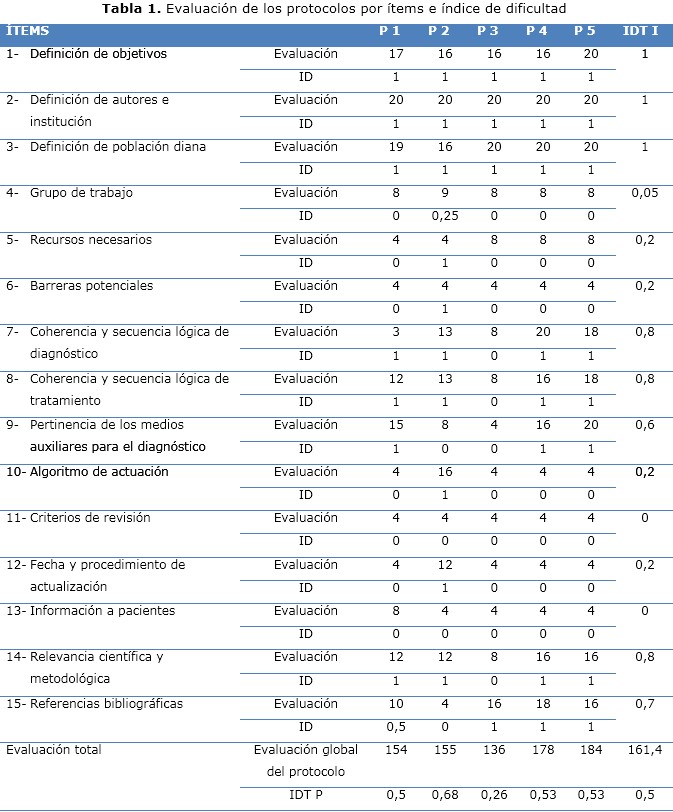
Methods: a cross sectional observational study was carried out for the protocolization of bruxism from a clinical perspective in Cuba and the world from February 2019 to February 2020.The universe of documents and researchers made it up: five protocols (four foreigners protocols and a national one) and an evaluation group made up of four dental professionals. A database was drawn up with the grade given to the assessment instrument with the Cuban scale formed by 15 items, divided into five categories that established an evaluation from one to five of the items, according to the opinion of each member of the assessment group.
Results: none of the existing assessed protocol got neither the maximum grade (300 points)nor the minimum one (60 points). The fourth and fifth protocols reached the highest grades with 178 and 184 points respectively as well as the same IDT P of 0,53.
Conclusions: these protocols the assistance of patients with bruxism did not reach the maximum possible grade, but they constitute scientific good decisions and incorporate, from one way or another, principles or functions to develop valid aspects in the good practice of dentistry.
DeCS: BRUXISM; BRUXISM/diagnosis; CLINICAL PROTOCOLS; PROCESS ASSESSMENT, HEALTH CARE; QUALITY OF HEALTH CARE.
Downloads
References
1. Grupo de trabajo de Enfermería. Guía metodológica para la elaboración de
protocolos basados en la evidencia [Internet]. España: Instituto Aragonés de Ciencias de la Salud (IACS), Departamento de Salud y Consumo; 2009 [citado 27 Sep 2019]. Disponible en: http://www.iacs.aragon.es
2. Sánchez Ancha Y, González Mesa FJ, Molina Mérida O, Guil García M. Guía para la elaboración de protocolos. Biblioteca Las casas [Internet]. 2011 [citado 25 Ene 2019];7(1):[aprox. 6 p.]. Disponible en:
http://www.index-f.com/lascasas/documentos/lc0565.php
3. Caja Costarricense de Seguro Social. Metodología para la Elaboración de Guías de Atención [Internet]. Costa Rica: Caja Costarricense de Seguro Social; 2007 [citado 17 Jun 2019]. Disponible en: https://www.binasss.sa.cr/libros/metodologia07.pdf
4. Morales Navarro D, Vila Morales D, Rodríguez Soto A. Evaluación de protocolos para la atención inicial del trauma maxilofacial grave. Rev Cubana Estomatol [Internet]. 2018 [citado 12 Dic 2018];55(2):[aprox. 15 p.]. Disponible en: http://scielo.sld.cu/scielo.php?script=sci_arttext&pid=S0034-75072018000200002&lng=es
5. Díaz Miralles M, Díaz Gómez SM, Hidalgo Hidalgo S, Viña Villafañas V, Paz Latorre E. Algoritmo preceptivo de variantes tipológicas del desgaste dentario en la guía anterior del paciente bruxópata. Congreso Internacional Estomatología 2020 (Virtual) [Internet]. La Habana: Facultad de Estomatología Raúl González Sánchez; 2020 [citado 12 Dic 2018]. Disponible en: http://www.estomatologia2020.sld.cu/index.php/estomatologia/2020/paper/viewFile/503/392
6. Ros Santana M. Protocolo para el diagnóstico y tratamiento de las Alteraciones del complejo cóndilo-disco e inflamatorias de la Articulación Temporomandibular [Tesis Doctoral]. Bayamo, Granma: Universidad de Ciencias Médicas de Granma, Facultad de Estomatología Celia Sánchez Manduley; 2015 [citado 12 Dic 2018]. Disponible en: http://tesis.sld.cu/index.php?P=FullRecord&ID=575&ReturnText=
Search+Results&ReturnTo=index.php%3FP%3DAdvancedSearch%26Q%3DY%26FK%3D-%2BRos%2BSantana%2BMarcos%2B%26RP%3D5%26SR%3D0%26
ST%3DQuick
7. Morales Navarro D. Propuesta de protocolo para el manejo inicial del trauma maxilofacial grave [Tesis Doctoral]. La Habana: Universidad de Ciencias Médicas de La Habana, Facultad de Estomatología Raúl González Sánchez; 2018 [citado 09 Oct 2019]. Disponible en: http://tesis.sld.cu/index.php?P=FullRecord&ID=623&ReturnText=Search+Results&ReturnTo=index.php%3FP%3DAdvancedSearch%26Q%3DY%26FK%3DDenia%2BMorales%2BNavarro%26RP%3D5%26SR%3D0%26ST%3DQuick
8. Sosa Rosales M de la C, Garrigó Andreu M I, Sardiña Alayón S, Gispert Abreu E, Valdés García P, Legón Padilla N, et al. Guías Prácticas de Estomatología. La Habana: Editorial Ciencias Médicas; 2003.
9. Proceso bienestar estudiantil. Subproceso Atención en Salud. Guía de Odontología para manejo y tratamiento del bruxismo [Internet]. Colombia: Universidad Industrial de Santander; 2008 [citado 15 Sep 2019]. Disponible en: https://www.uis.edu.co/intranet/calidad/documentos/bienestar_estudiantil/guias/GBE.61.pdf
10. Servicio de Salud Metropolitano Norte. Protocolo de referencia y contrarreferencia para la especialidad de trastornos temporomandibulares y dolor orofacial [Internet]. Costa Rica: Servicio de Salud Metropolitano Norte; 2017[citado 13 Sep 2019]. 18 p. Disponible en: https://www.ssmn.cl/descargas/protocolos_referencia_contrareferencia/hospital_clinico_san_jose/odontologia/Protocolo_TTM_DOF_SSMN.pdf
11. Mesko ME, Hutton B, Skupien JA, Sarkis-Onofre R, Moher D, Pereira-Cenci T. Therapies for bruxism: a systematic reviewing network meta-analysis (protocol). Syst Rev [Internet]. 2017 [citado 13 Sep 2019];6:[aprox. 4 p.]. Disponible en: https://www.ncbi.nlm.nih.gov/pmc/articles/PMC5237268/.
12. Lange M. The Bruxism Status Examination Protocol. Quintessence Publishing USA [Internet]. 2017 [citado 13 Sep 2019];9(1). Disponible en: https://www.researchgate.net/publication/317888309_The_Bruxism_Status_Examination_Protocol
13. Hernández Reyes B, Díaz Gómez SM, Hidalgo Hidalgo S, Lazo Nodarse R. Bruxismo: panorámica actual. Arch med Camagüey [Internet]. 2017 [citado 26 Sep 2019];21(1). Disponible en: http://revistaamc.sld.cu/index.php/amc/article/view/4817/2664
14. Díaz Miralles M, Díaz Gómez SM, Viña Villafaña V, Hidalgo Hidalgo S. Experiencia en una institución de salud mental de un programa Instructivo para pacientes con bruxismo. Congreso Internacional Estomatología 2020 (Virtual) [Internet]. La Habana: Facultad de Estomatología Raúl González Sánchez; 2020 [citado 12 Ene 2021]. Disponible en: http://estomatologia2020.sld.cu/index.php/estomatologia/2020/paper/view/489/367
15. Fabila Echauri AM, Minami H, Izquierdo Sandoval MJ. La escala de Likert en la evaluación docente: acercamiento a sus características y principios metodológicos. Perspectivas Docentes [Internet]. 2012 [citado 21 Feb 2019];(50):[aprox. 10 p.]. Disponible en: https://dialnet.unirioja.es/servlet/articulo?codigo=6349269
16. Organización de Naciones Unidas. Declaración de Helsinki. En: ONU, editor. Manual de ética [Internet]. Asunción (Paraguay): Universidad Autónoma de Asunción, Facultad de Ciencias de la Salud, Carrera Odontología; 2014 [citado 02 Feb 2020]. Disponible en: http://www.uaa.edu.py/facultades_carreras/salud/download/manual-de-etica -FCS.pdf
17. Arias Capote JC, Hidalgo Mesa CJ, Hidalgo Cepero HE. Utilidad de las guías, protocolos y algoritmos en la práctica clínica. Rev cubana med [Internet]. Ene-Mar 2019 [citado 03 Jun 2021];58(1). Disponible en: http://scielo.sld.cu/scielo.php?script=sci_arttext&pid=S0034-75232019000100005
18. Arredondo Bruce A. La actualización del método clínico. Rev cubana med [Internet]. 2019 [citado 02 Feb 2021];58(1):[aprox. 12 p.]. Disponible en: http://scielo.sld.cu/pdf/med/v58n1/1561-302X-med-58-01-e977.pdf
19. Vaca Coronel GM, Erazo Vaca RX, Tutasi Benítez RV. Método clínico: su importancia en el desarrollo de habilidades diagnósticas en la asignatura de Medicina interna de la Carrera de Odontología. Revista Conrado [Internet]. 2017 [citado 20 Dic 2020];13(58):[aprox. 7 p.]. Disponible en: https://conrado.ucf.edu.cu/index.php/conrado/article/view/502
20. Canelo Aybar C, Balbin G, Pérez Gómez A, Flórez ID. Guías de práctica clínica en el Perú: evaluación de su calidad usando el instrumento AGREE II. Rev Perú Med Exp Salud Pública [Internet]. 2016 [citado 17 Feb 2020];33(4):[aprox. 8 p.]. Disponible en: https://www.redalyc.org/pdf/363/36349330018.pdf
21. Navarro Noya S, Padilla Rodríguez CM. Indicadores estadísticos para la evaluación de protocolos asistenciales en oftalmología. Rev Cubana Oftalmol [Internet]. Ene-Mar 2015 [citado 15 Dic 2020];28(1). Disponible en: http://scielo.sld.cu/scielo.php?script=sci_arttext&pid=S0864-21762015000100008
22. Mendieta Pedroso M, Sotolongo López JC. El pronóstico y su importancia en la práctica clínica. Rev Cubana Med [Internet]. 2019 [citado 20 Ene 2021];58(3). Disponible en: http://revmedicina.sld.cu/index.php/med/article/view/1322
23. Barrera Cruz A, Viniegra Osorio A, Valenzuela Flores AA, Torres Arreola LP, Dávila Torres J. Metodología para el desarrollo y la actualización de guías de práctica clínica: estado actual. Rev Med Inst Mex del Seguro Soc [Internet]. 2016 [citado 20 Ene 2020];54(1):[aprox. 13 p.]. Disponible en: https://www.redalyc.org/pdf/4577/457745148019.pdf
Published
How to Cite
Issue
Section
License
Copyright (c) 2021 Silvia María Díaz-Gómez, Martha Díaz-Miralles, María Elena Gutiérrez-Hernández, IIeana Bárbara Grau-León, Tania Victoria Puerto-Pérez, Alina Adela Jiménez-Rodríguez

This work is licensed under a Creative Commons Attribution-NonCommercial 4.0 International License.
Copyright: Camagüey Medical Archive Magazine, offers immediately after being indexed in the SciELO Project; Open access to the full text of the articles under the principle of making available and free the research to promote the exchange of global knowledge and contribute to a greater extension, publication, evaluation and extensive use of the articles that can be used without purpose As long as reference is made to the primary source.
Conflicts of interest: authors must declare in a mandatory manner the presence or not of conflicts of interest in relation to the investigation presented.
(Download Statement of potential conflicts of interest)
The Revista Archivo Médico de Camagüey is under a License Creative Commons Attribution-Noncommercial-No Derivative Works 4.0 International (CC BY 4.0).
This license allows others to distribute, to mix, to adjust and to build from its work, even for commercial purposes, as long as it is recognized the authorship of the original creation. This is the most helpful license offered. Recommended for maximum dissemination and use of licensed materials. The full license can be found at: https://creativecommons.org/licenses/






 22 julio 2025