

Prosthetic rehabilitation in maxillary defect
Abstract
Background: the prosthetic treatment with chokes in patients with maxillary defects, either for oncological, traumatic cause, or for congenital defects, should be intended to give back the basic functions. Separating the oral cavity from the nasal is aimed at giving back the swallowing, phonation, chewing to the patient, in addition to an acceptable esthetics.
Objective: to describe the confection of an obturating prosthesis of the palate of acrylic resin.
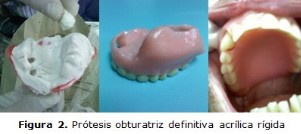
Clinical case: a 69-year old white man from Minas shows up at Julio Antonio Mella clinic in Camaguey in order to change the protrusive prosthesis in use. In the interrogation the patient referred having been intervened surgically of a carcinoma in the jawbone in which an orifice in the mouth was left as consequence that communicates the oral cavity with the nasal one, which put at risk important functions such as the swallowing, breathing, aesthetics and phonation. The treatment plan consisted in the elaboration of a new protrusive rigid acrylic prosthesis.
Conclusions: when using a protrusive rigid prosthesis the aesthetics desired by the patient and his morfofunctional rehabilitation were achieved, giving back to him the lost functions and bolstering up his self-esteem.
DeCS: MAXILLOFACIAL PROSTHESIS; CARCINOMA, SQUAMOUS CELL; PALATAL OBTURATORS; AGED; CASE REPORTS.
Downloads
References
1.Luna Pentón Y, Barreto Ortega M, Pérez García LM, Rodríguez Pimienta EM. Morbilidad de los defectos bucomaxilofaciales en Sancti Spíritus. Noviembre 1998-diciembre 2010. Gac Méd Espirit [Internet]. Abr 2016 [citado 2 Oct 2016];18(1):[aprox. 10 .p.]. Disponible en: http://scieloprueba.sld.cu/scielo.php?script=sci_arttext&pid=S1608-89212016000100005&lng=es
2.Malard O, Lanhouet J, Michel G, Dreno B, Espitalier F, Rio E. Full-thickness nasal defect: Place of prosthetic reconstruction. Eur Ann Otorhinolaryngol Head Neck Dis [Internet]. 2015 Apr [citado 2016 Oct 2];132(2):[about 4 .p.]. Available from: http://www.sciencedirect.com/science/article/pii/S18797296140017073
3.Colectivo de Autores. Prótesis bucomaxilofacial. Procedimientos clínicos [Internet]. La Habana: Editorial Ciencias Médicas; 2013 [citado 2 Oct 2016]. Disponible en: http://www.bvs.sld.cu/libros_texto/procederes_bas_clin_prot_bucomax/procederes_basico_clin_prote02.pdf
4.Luján Larreategui H, Pineda Mejia M. Prótesis mucosoportada en la rehabilitación de un paciente totalmente edéntulo con fisura palatina. Odontol Sanmarquina [Internet]. 2015 [citado 18 Mar 2017];18(1):[aprox. 3 .p.]. Disponible en: http://revistasinvestigacion.unmsm.edu.pe/index.php/odont/article/view/11341
5.Escanaverino Oliva M, Bermúdez Alemán R, López de Castro Alonso A, Cabañín Recalde T. La rehabilitación de la comunicación buconasal. Medicentro [Internet]. 2010 [citado 22 Ago 2015];14(4 Supl 1):[aprox. 2 p.]. Disponible en: http://www.medicentro.sld.cu/index.php/medicentro/article/viewFile/231/261
6.Meras Jáuregui TM, Morales Pérez YJ, Cazañas Montero R, Guardado Valdés Y. Repercusión de la rehabilitación con prótesis obturatriz en pacientes tratados en el Centro de Prótesis Bucomaxilofacial. Medicentro [Internet]. 2015 [citado 2 Feb 2017];19(2):[aprox. 10 p.]. Disponible en: http://www.medicentro.sld.cu/index.php/medicentro/article/view/1801/1519
7.Omar A, Gutiérrez G. Prótesis nasales: alternativa de manejo para casos especiales. Acta otorrino-laringológica de Colombia [Internet]. 2012 Mar [citado 2 Oct 2016];Supl:[aprox. 11 .p.]. Disponible en: http://www.acorl.org.co/articulos/141208080117.pdf
8.Aguiar L, Mozzini AR, Lersch E, Conto F de. Obturador palatino: confecção de umaprótesenão convencional-relato de caso. RFO UPF [Internet]. Abr 2013 [citado 24 Ene 2017];18(1):[aprox. 4 p.]. Disponible en: http://revodonto.bvsalud.org/scielo.php?script=sci_arttext&pid=S1413-40122013000100021&lng=pt
9.Dib VN, Baino MA, Leonardi G de. Rehabilitación clínica de un defecto maxilar. Rev Claves Ediciones [Internet]. Abr 2015 [citado 2 Feb 2017];22(74):[aprox. 7 p.]. Disponible en: http://www.coc-cordoba.org.ar/claves/revistaclaves74/article3.html
10.Colectivo de Autores. Prótesis bucomaxilofacial. Procedimiento de laboratorio [Internet]. La Habana: Editorial Ciencias Médicas; 2013 [citado 11 Ene 2016]. Disponible en: http://www.bvs.sld.cu/libros_texto/protesisbucomaxilofacial_procedimientos_asistenciales3raed/protesisbucomax_proc_asist_3raed_completo.pdf
Published
How to Cite
Issue
Section
License
Copyright (c) 2017 Isidro Nápoles González, Ana María Nápoles Salas, Yaimara Riverón Martínez, Alfonso Buceta Área

This work is licensed under a Creative Commons Attribution-NonCommercial 4.0 International License.
Copyright: Camagüey Medical Archive Magazine, offers immediately after being indexed in the SciELO Project; Open access to the full text of the articles under the principle of making available and free the research to promote the exchange of global knowledge and contribute to a greater extension, publication, evaluation and extensive use of the articles that can be used without purpose As long as reference is made to the primary source.
Conflicts of interest: authors must declare in a mandatory manner the presence or not of conflicts of interest in relation to the investigation presented.
(Download Statement of potential conflicts of interest)
The Revista Archivo Médico de Camagüey is under a License Creative Commons Attribution-Noncommercial-No Derivative Works 4.0 International (CC BY 4.0).
This license allows others to distribute, to mix, to adjust and to build from its work, even for commercial purposes, as long as it is recognized the authorship of the original creation. This is the most helpful license offered. Recommended for maximum dissemination and use of licensed materials. The full license can be found at: https://creativecommons.org/licenses/






 22 julio 2025