

Regeneración celular en los defectos óseos segmentarios
Abstract
Introduction: Segmental bone defects are produced by high-energy traumas that cause acute bone loss, occur sub-acutely during surgical debridement of an exposed fracture, and can also be seen in chronic cases such as pseudarthrosis and osteomyelitis, drastically altering the quality of life of the patient.
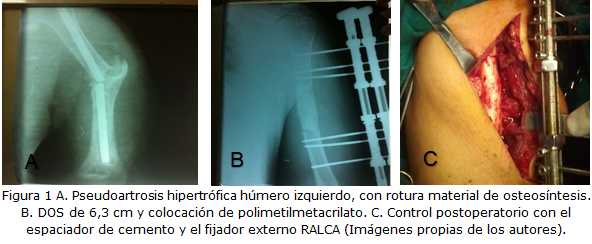
Objective: To present a patient with a segmental bone defect secondary to hypertrophic nonunion of the right humerus measuring 6.3 cm.
Case report: A 45-year-old male patient, Caucasian, with no personal pathological history, who came to our office referred from another health institution with a diagnosis of hypertrophic pseudoarthrosis of the right humerus of 3 years of evolution. The membrane induction technique (Masquelet) is performed, which was combined with the implantation of autologous adult stem cells in the second surgical time. Bone union was achieved at 12 weeks.
Conclusions: Within the therapeutic variants of the segmental bone defects, the membrane induction technique stands out, which in combination with the use of cell therapy constitutes a promising option, taking into account that a smaller graft volume is needed, rapid consolidation, as well as an economical alternative, and easy to make without great technological complexity.
DeCS: HUMERAL FRACTURES/complications; REGENERATIVE MEDICINE; STEM CELLS; CELL-AND TISSUE-BASED THERAPY; CASE REPORTS.
Downloads
References
1. Vejarano-Solano JC, Ruiz–Semba CF, Ganoza-Arróspide CJ, Hurtado–Fernández JE. Reconstrucción de defectos óseos segmentarios postraumáticos mediante técnica de inducción de membrana. Rev Med Hered [Internet]. 2015 [citado 13 Abr 2023];26:76-85. Disponible en: http://www.scielo.org.pe/pdf/rmh/v26n2/a03v26n2.pdf
2. Masquelet AC, Fitoussi F, Begue T, Muller GP. Reconstruction of the long bones by the induced membrane and spongy autograft. Ann Chir Plast Esthet [Internet]. 2000 Jun [citado 13 Abr 2023];45(3):346-53. Disponible en: https://pubmed.ncbi.nlm.nih.gov/10929461/
3. Quesada Leyva L, León Ramentol CC, Fernández Torres S, Nicolau Pestana E. Células madre: una revolución en la medicina regenerativa. Medisan [Internet]. 2017 May [citado 13 Ene 2023];21(5). Disponible en: http://scielo.sld.cu/scielo.php?script=sci_arttext&pid=S1029-30192017000500009
4. Álvarez Cambras R, Díaz Hernández F, Rigau Bacallao P, Barreda Pérez H, Cintas Fernández F. Tratamiento de la seudoartrosis con el fijador externo del profesor Rodrigo Alvarez Cambras. Rev cuba ortop traumatol.1987;2(2):7-16.
5. Boyum A. Separation of White Blood Cells. Nature [Internet]. 1964 Nov [citado 20 Feb 2023];204:793-4. Disponible en: https://pubmed.ncbi.nlm.nih.gov/14235685/
6. Pesciallo C, Garabano G, Montero Vinces A, Gómez DJ, Bidolegui F, Cid Casteulani A. Defectos óseos segmentarios infectados en huesos largos: tratamiento con técnica de Masquelet. Rev Asoc Argent Ortop Traumatol [Internet]. 2019 Mar [citado 20 Feb 2023];84(1):15-26. Disponible en: http://www.scielo.org.ar/scielo.php?script=sci_arttext&pid=S1852-74342019000100004
7. Sullca Farge MU. Reconstrucción de pseudoartrosis atrófica humeral mediante técnica de Masquelet más injerto no vascularizado de peroné, informe de un caso [tesis]. Trujillo: Universidad Privada Antenor Orrego; 2020 [citado 20 Ene 2023]. Disponible en http://repositorio.upao.edu.pe/bitstream/20.500.12759/6531/1/REP_MIGUEL.SULLCA_RECONSTRUCCI%c3%93N.DE.PSEUDOARTROSIS.pdf
8. López Hernández FO. Revisión acetabular primaria: incidencia y mecanismos de utilización del injerto óseo. Rev cuba ortop traumatol [Internet]. 2021 [citado 20 Ene 2023];35(2). Disponible en: https://revortopedia.sld.cu/index.php/revortopedia/article/view/460
9. Gabl M, Pechlaner S, Zimmermann R. Injerto libre vascularizado de cresta iliaca para el tratamiento de la pseudoartrosis de escafoides con fragmento proximal avascular. Tec Quir Ortop Traumatol [Internet]. 2011 [citado 29 Jun 2023];20(1):26-38. Disponible en: https://www.elsevier.es/es-revista-tecnicas-quirurgicas-ortopedia-traumatologia-41-pdf-X1132195411020394
10. Karger C, Kishi T, Schneider L, Fitoussi F, Masquelet AC. Treatment of posttraumatic bone defects by the induced membrane technique. Orthop Traumatol Surg Res [Internet]. 2012 Feb [citado 20 Ene 2023];98(1):97-102. Disponible en: https://pubmed.ncbi.nlm.nih.gov/22244249/
11. Pelissier P, Masquelet AC, Bareille R, Mathoulin Pelissier S, Amedee J. Induced membranes secrete growth factors including vascular and osteoinductive factors and could stimulate bone regeneration. J Orthop Res [Internet]. 2004 [citado 20 Mar 2023];22:73-9. Disponible en: https://onlinelibrary.wiley.com/doi/pdf/10.1016/S0736-0266(03)00165-7
12. Donegan DJ, Scolaro J, Matuszewski PE, Mehta S. Staged bone grafting following placement of an antibiotic spacer block for the management of segmental long bone defects. Orthopedics [Internet]. 2011 Nov [citado 20 Mar 2023];34(11):e730-5. Disponible en: https://pubmed.ncbi.nlm.nih.gov/22049954/
13. O'Scholz A, Gehrmann S, Glombitza M, Kaufmann R, Bostelmann R, Flohe S, et al. Reconstruction of septic diaphyseal bone defects with the induced membrane technique. Injury [Internet]. 2015 [citado 20 Mar 2023];46 Suppl 4:S121-S124. Disponible en: https://pubmed.ncbi.nlm.nih.gov/26542857/
14. Lara-Villca R, Undurraga-Carmona N. Técnica de membrana inducida en la reconstrucción de defectos óseos postraumáticos. Gac Med Bol [Internet]. 2018 Dic [citado 13 Ene 2023];41(2). Disponible en: http://www.scielo.org.bo/scielo.php?script=sci_arttext&pid=S1012-29662018000200005
Published
How to Cite
Issue
Section
License
Copyright (c) 2023 Yandri Bornot-Duránd, Gleibis Amparo Ferrer-Matos

This work is licensed under a Creative Commons Attribution-NonCommercial 4.0 International License.
Copyright: Camagüey Medical Archive Magazine, offers immediately after being indexed in the SciELO Project; Open access to the full text of the articles under the principle of making available and free the research to promote the exchange of global knowledge and contribute to a greater extension, publication, evaluation and extensive use of the articles that can be used without purpose As long as reference is made to the primary source.
Conflicts of interest: authors must declare in a mandatory manner the presence or not of conflicts of interest in relation to the investigation presented.
(Download Statement of potential conflicts of interest)
The Revista Archivo Médico de Camagüey is under a License Creative Commons Attribution-Noncommercial-No Derivative Works 4.0 International (CC BY 4.0).
This license allows others to distribute, to mix, to adjust and to build from its work, even for commercial purposes, as long as it is recognized the authorship of the original creation. This is the most helpful license offered. Recommended for maximum dissemination and use of licensed materials. The full license can be found at: https://creativecommons.org/licenses/






 22 julio 2025