

Risk factors associated with congenital defects of the external genitalia and male gonads
Abstract
Introduction: Congenital defects of the urogenital tract are among the anomalies most found in the fetus or neonate, which gives an idea of their extraordinary clinical importance, together with the few investigations in the Camagüey province, on risk factors associated with congenital defects of external genitalia and male gonads.
Objective: To determine the risk factors associated with congenital defects of the external genitalia and male gonads.
Methods: A retrospective correlational study was carried out at the Eduardo Agramonte Piña Pediatric Hospital from January 2013 to December 2020. The universe was made up of the 96 patients who underwent surgery for presenting congenital defects of the external genitalia and male gonads. To determine the association of the risk factors with the appearance of congenital defects, the independence test was used; in case of p
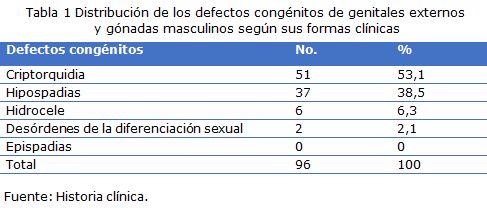
Results: Cryptorchidism was the clinical form with the highest number of patients, followed by hypospadias and hydrocele. The association between farm worker parents and hypospadias and cryptorchidism with industrial worker parents was significant. The fact that the mother was a passive smoker was a variable with a significant association, both for the appearance of hypospadias and cryptorchidism. Being a passive smoker was the risk factor that had the highest correlation with the appearance of birth defects.
Conclusions: There were risk factors with a significant association with the appearance of congenital defects of the external genitalia and male gonads.
DeCS: GENITALS/abnormalities; GENITALIA, MALE/abnormalities; RISK FACTORS; CRYPTORCHIDISM; UROGENITAL ABNORMALITIES.
Downloads
References
1. Sadler TW. Langman Embriología Médica. 13a ed. Barcelona: Wolters Kluwer; 2016.
2. Torres-Hernández D, Flecher-Toledo T, Ortiz-Martínez RA, Acosta-Aragón MA, Moreno-Montenegro LL, Otalora-Perdomo MF. Factores asociados al desarrollo de anomalías congénitas en la población neonatal atendida en un hospital de alta complejidad en Colombia: estudio de casos y controles. Rev chil obstet ginecol [Internet]. 2021 Jun [citado 20 Nov 2022];86(3). Disponible en: https://www.scielo.cl/scielo.php?pid=S071775262021000300301&script=sci_arttext
3. Corrales-Sánchez C, Gallardo-Carvajal A, Borenstein-Guelman M. Hipospadias: desde el diagnóstico ecográfico prenatal hasta el manejo posnatal. Rev chil obstet ginecol [Internet]. 2023 [citado 20 Abr 2023];88(1). Disponible en: https://www.scielo.cl/scielo.php?script=sci_arttext&pid=S071775262023000100071&Ing=en
4. Colectivo de autores. Temas de Urología [Internet]. La Habana: Editorial Ciencias Médicas; 2008 [citado 06 Dic 2022]. Disponible en: http://www.bvs.sld.cu/libros_texto/temas_urologia/completo.pdf
5. Gaviria Gil F, Benavides JA, Saldarriaga JF, Henao M. Nueva Técnica para el manejo de hipospadias refractaria en niños. Urol Colomb [Internet]. 2019 [citado 06 Dic 2022];28:92-96. Disponible en: https://www.thieme-connect.com/products/ejournals/pdf/10.1055/s-0038-1645848.pdf
6. Jiménez Abreu SE, Pérez González JA, Martínez Lemus O, Díaz Rodríguez L. Hipospadia escrotal en un recién nacido. Presentación de un caso. Panorama. Rev Cuba y Salud [Internet]. 2018 [citado 06 Dic 2022];13(2):131-3. Disponible en: https://revpanorama.sld.cu/index.php/panorama/article/view/131-133/pdf_311
7. Gómez-Pamatz FG, Landa-Román C, Tapia-Garibay JI. Asociación entre hipospadias y criptorquidia con anquiloglosia y anquiloquilia en pacientes del Hospital Infantil de Morelia. Rev Mex Urol [Internet]. 2020 [citado 20 Oct 2022];80(4):1-10 Disponible en: https://www.medigraphic.com/pdfs/uro/ur-2020/ur204c.pdf
8. Armas-Alcántara LE, Gamboa-Olivares MJ, Ignacio-Conchoy FL. Características clínico-ecográficas pre y postquirúrgicas de niños intervenidos por criptorquidia en el Hospital Sabogal, Perú. Rev Cuerpo Med HNAAA [Internet]. 2022 Jul-Sep [citado 20 Abr 2023];15(3). Disponible en: http://www.scielo.org.pe/scielo.php?script=sci_arttext&pid=S222747312022000300008
9. Jones KL, Jones MC, del Campo M. Smith’s Recognizable Patterns of Human Malformation. 8a ed [Internet]. Barcelona: Elsevier Saunders;2021 [citado 06 Dic 2022]. Disponible en: https://www.amazon.com/Smiths-Recognizable-Patterns-Human-Malformation/dp/0323638821
10. Cruz Hernández EL, Caveda Carrasco R, Hernández Campo PR, Bacallao Seruto N, Hernández Hernández Z. Caracterización andrológica de pacientes operados por criptorquidia en Pinar del Río (2015-2018). Rev cuban urol [Internet]. 2022 [citado 06 Dic 2022];11(2). Disponible en: https://revurologia.sld.cu/index.php/rcu/article/view/804/762
11. Bozán Frómeta I, León Márquez C, Díaz Melián M, Lago YZ. Comportamiento de los defectos congénitos en el municipio de Cabaiguán. Año 2006-2011. Gac Méd Espirit [Internet]. 2012 [citado 06 Dic 2022];14(3). Disponible en: https://revgmespirituana.sld.cu/index.php/gme/article/view/194/149
12. Domínguez Chicas A. Principales enfermedades en urología pediátrica: manifestaciones clínicas, abordaje, diagnóstico y tratamiento. Rev Conamed [Internet]. 2018 [citado 08 Dic 2020];23(3):132-40. Disponible en: https://www.medigraphic.com/pdfs/conamed/con-2018/con183d.pdf
13. Loza Cordero C, Mejía Salas H. Caracterización clínico epidemiológica de criptorquidia en pacientes internados del hospital del niño Ovidio aliaga Uría. Rev Med La Paz [Internet]. 2017 [citado 07 Dic 2022];23(1). Disponible en: http://www.scielo.org.bo/scielo.php?script=sci_arttext&pid=S1726-89582017000100005
14. Partin A, Peters C, Kavoussi L, Dmochowski R, Wein A. Campbell Walsh Wein Urology. 12th ed [Internet]. Philadelphia: Elsevier; 2020 [citado 21 Jun 2022]. Disponible en: https://www.amazon.com/Campbell-Walsh-Wein-Urology-Campbell-Walsh/dp/0323546420
15. Fernández N, Pérez J, Zarante I. Son las hipospadias la expresión de diferentes enfermedades? MAMLD 1: un nuevo gen candidato para hipospadias. Urol Colomb [Internet]. 2015 [citado 21 Jun 2022];24(3):155-60. Disponible en: https://repository.javeriana.edu.co/bitstream/handle/10554/49770/S0120789X15000714.pdf?sequence=1&isAllowed=y
16. Pombo Arias M, Castro-Feijóo L, Barreiro Conde J, Cabanas Rodriguez P. Una revisión sobre los disruptores endocrinos y su posible impacto sobre la salud de los humanos. Rev Esp Endocrinol Pediatr [Internet]. 2020 [citado 21 Jun 2022];11(2). Disponible en: https://www.endocrinologiapediatrica.org/revistas/P1-E35/P1-E35-S2799-A619.pdf
17. Benítez-Leite S, Macchi ML, Acosta M. Malformaciones Congénitas Asociadas a Agrotóxicos. Rev chil pediatr [Internet]. 2009 Ago [citado 07 Dic 2022];80(4). Disponible en: https://www.scielo.cl/scielo.php?script=sci_arttext&pid=S0370-41062009000400010
18. Audí L, Fernández-Cancio M. Etiopatogenia del hipospadias. Rev Esp Endocrinol Pediátr [Internet]. 2014 [citado 07 Dic 2022];5(Suppl). Disponible en: https://www.endocrinologiapediatrica.org/revistas/P1-E9/P1-E9-S300-A226.pdf
19. Molina LA, Montenegro GK. Prevalencia y factores de riesgo de criptorquidia en niños menores de 4 años en los centros de desarrollo infantil del MIES de la ciudad de Cuenca [tesis]. Cuenca: Universidad de Cuenca; 2014 [citado 07 Dic 2022]. Disponible en: http://dspace.ucuenca.edu.ec/bitstream/123456789/6425/1/TESIS.pdf
20. Huertas AL, Espinosa Gongora R, Muñoz Calvo MT. Patología del descenso testicular. Pediatr Integral [Internet]. 2014 [citado 07 Dic 2022];XVIII(10):718-728. Disponible en: https://www.pediatriaintegral.es/wpcontent/uploads/2014/xviii10/01/n10-718-728_Maite_Munoz.pdf
21. Yang Q, Qu WY, Yang L, Wang K, Tu HY, Wang J. Literature on the aetiology of hypospadias in the last 5 years: molecular mechanism and environmental factors. Andrología [Internet]. 2014 [citado 21 Jun 2022];46:583-91. Disponible en: https://onlinelibrary.wiley.com/doi/pdf/10.1111/and.12125
22. Estors Sastre B, Bragagnini Rodriguez P, Fernandez Atuan R, Delgado Alvira R, Rihuete Heras MA, Gracia Romero J. Exposición a disruptores endocrinos y otros factores paternos en la etiología del hipospadias y la criptorquidia. Cir Pediatr [Internet]. 2015 [citado 08 Dic 2020];28:128-32. Disponible en: https://www.secipe.org/coldata/upload/revista/2015_28-3_128-132.pdf
23. Cebrián Muiños C. Criptorquidia y patología testículo escrotal en la edad pediátrica. Pediatr Integral [Internet]. 2019 [citado 21 Jun 2022];XXII(6):271-82. Disponible en: https://www.pediatriaintegral.es/wpcontent/uploads/2019/xxiii06/01/n6-271-282_CarmenCebrian.pdf
24. Carrión Campoverde ML, Rivera Verdesoto FM. Prevalencia de criptorquidia y factores asociados en pacientes pediátricos Riobamba, 2016-2019 [tesis]. Riobamba: Universidad Nacional de Chimborazo; 2020 [citado 07 Dic 2022]. Disponible en: http://dspace.unach.edu.ec/bitstream/51000/7055/1/Miriam%20Lilibeth%20Carri%c3%b3n%20Campoverde%20y%20Fabian%20Mateo%20Rivera-Med.pdf
25. Gómez Tabares G, Mordecay VC. Disruptores endocrinos en reproducción. Rev Colomb de menopaus [Internet]. 2020 [citado 07 Dic 2022];26(1):7-19. Disponible en: https://docs.bvsalud.org/biblioref2021/05/1224400/disruptoresendocrinos.pdf&ved=2ahUKEwj9HLxY77AhVfmIQIHagBAm8QFnoECA$QAQ&usg=AOvVaw3GRET&GvTgMtJYa6MhosAi
Published
How to Cite
Issue
Section
License
Copyright (c) 2023 Marisbel Alonso-Benavente, Maryelis de la Caridad Esquivel-González, Tania Puerto-Pérez, Kenia Pérez-de-Zayas, Cynara Mirón-Folgoso

This work is licensed under a Creative Commons Attribution-NonCommercial 4.0 International License.
Copyright: Camagüey Medical Archive Magazine, offers immediately after being indexed in the SciELO Project; Open access to the full text of the articles under the principle of making available and free the research to promote the exchange of global knowledge and contribute to a greater extension, publication, evaluation and extensive use of the articles that can be used without purpose As long as reference is made to the primary source.
Conflicts of interest: authors must declare in a mandatory manner the presence or not of conflicts of interest in relation to the investigation presented.
(Download Statement of potential conflicts of interest)
The Revista Archivo Médico de Camagüey is under a License Creative Commons Attribution-Noncommercial-No Derivative Works 4.0 International (CC BY 4.0).
This license allows others to distribute, to mix, to adjust and to build from its work, even for commercial purposes, as long as it is recognized the authorship of the original creation. This is the most helpful license offered. Recommended for maximum dissemination and use of licensed materials. The full license can be found at: https://creativecommons.org/licenses/






 22 julio 2025