

Curricular analysis of the teaching-learning process of fluoride’s use in the General Dentistry discipline
Abstract
Introduction: The teaching-learning process of methods for the prevention and control of dental caries in dentistry requires academic training that involves knowledge and development of skills in the use of fluoride.
Objective: To analyze the contribution of the programs of the subjects of General Dentistry discipline in the Plan E of Dentistry career to the systematic teaching and learning process of the use of fluoride.
Methods: A qualitative research was carried out by revising curricular documents of the studies and programs of the subjects of General Dentistry discipline of Plan E. Themes, contents, objectives and systems of abilities, methodological orientations and curricular strategies of the programs were analyzed as well as their relationship with the teaching-learning process of the use of fluoride.
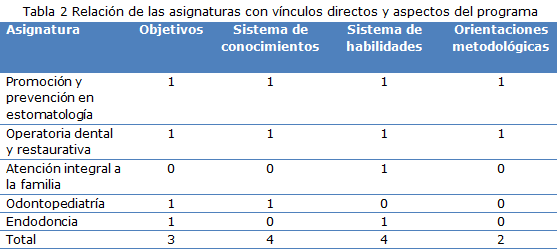
Results: The eight subjects that contribute to the leaning of the use of fluoride cover all the academic years of the dental studies. More than half of the subjects directly considers this topic in their programs. Three of the subjects has indirect approach of the topic in question, and it is not taught in the content or abilities in the program. The teaching of the use of fluoride was emphasized in the knowledge system and system of abilities, followed by the objective. It was only covered in two subjects, in the methodological orientations.
Conclusions: The structure of the curricular design makes possible the system approach of the teaching-learning process of the use of fluoride. Unfortunately, there is no a strategy of the discipline that guarantees systematization of the knowledge of preventive and healing actions.
DeCS: FLUORINE; EDUCATION, DENTAL; EDUCACIÓN BASADA EN COMPETENCIAS; CURRICULUM; LEARNING.
Downloads
References
1. Gispert Abreu E. La Estomatología ante el reto de la salud universal. Rev cuba estomatol [Internet]. 2018 [citado 10 Jun 2021]; 55(2). Disponible en: https://revestomatologia.sld.cu/index.php/est/article/view/1902/413
2. Yero Mier IM, Morgado Marrero DE, García Rodríguez M, Mursuli Sosa MZ, Castro Gutiérrez I, Rodríguez Betancourt MC. Intervención educativa para la percepción del riesgo a la caries dental en estudiantes de 7.mo grado. Sancti Spíritus. Gac Méd Espirit [Internet]. 2020 [citado 10 Jun 2021]; 22(2). Disponible en: https://revgmespirituana.sld.cu/index.php/gme/article/view/2048/2118
3. Aránguiz-Freyhofer V, Marró-Freitte ML, Ramírez-Lobos V, Moncada-Cortes G. Contenidos de cariología impartidos por escuelas dentales chilenas: Estudio transversal. Rev Clin Periodoncia Implantol Rehabil Oral [Internet]. 2019 [citado 10 Jun 2021]; 12(1): 31-36. Disponible en: https://www.scielo.cl/pdf/piro/v12n1/0719-0107-piro-12-01-00031.pdf
4. Guerrero Concepción A, Domínguez-Guerrero R. Fluorosis dental y su prevención en la atención primaria de salud. Revista Electrónica Dr. Zoilo E. Marinello Vidaurreta [Internet]. 2018 [citado 10 Jun 2021];43(3):[aprox. 5 p.]. Disponible en: http://www.revzoilomarinello.sld.cu/index.php/zmv/article/view/1189
5. Acosta de Camargo MG, Palencia l, Santaella J, Suárez l. El uso de fluoruros en niños menores de 5 años. Evidencia. Revisión bibliográfica. Revista Odontopediatria Latinoamericana [Internet]. 2020 Ene-Jun [citado 10 Jun 2021]; 10(1). Disponible en: https://www.medigraphic.com/pdfs/alop/rol-2020/rol201h.pdf
6. Gouvea DB, Groisman S, Strazzeri Bönecker MJ, Sampaio F, Martins Paiva S, Kriger L, et al. Cariology education for undergraduate Brazilian dental. RGO, Rev Gaúch de Odontol [Internet]. 2018 [citado 10 Jun 2021]; 66(3). Disponible en: https://www.scielo.br/j/rgo/a/wQKHffrXSgDJ3ySS4YwPrKw/?format=pdf&lang=en
7. Naranjo Sierra MC. Enseñanza de la cariología en la Facultad de Odontología de la Universidad Nacional de Colombia. Acta Odontológica Colombiana [Internet]. 2013 [citado 17 Ago 2022]. Disponible en: https://repositorio.unal.edu.co/bitstream/handle/unal/72833/39080-173890-1-PB.pdf?sequence=1&isAllowed=y
8. Ministerio de Salud Pública. La formación del Estomatólogo General Básico. Plan de Estudios D de la carrera. Características generales. La Habana: Editorial Ciencias Médicas; 2011.
9. Toledo Reyes L, Díaz Velis Martínez E, Cobas Vilches ME. Pertinencia del trabajo metodológico para la funcionalidad de la disciplina integradora en Estomatología. Edumecentro [Internet]. 2017 [citado 10 Jun 2021]; 9(1). Disponible en: https://revedumecentro.sld.cu/index.php/edumc/article/view/747/html_208
10. Hernández-González LM, Torralba-Jova MA, Lima-Ruiz K, Blanco-Ruiz Y, Espinosa-Morales L, Benítez-Valdivia RR. Atención estomatológica preventiva en menores de 19 años de Ciego de Ávila en el quinquenio 2014-2018. Mediciego [Internet]. 2020 [citado 10 Jun 2021]; 26(2). Disponible en: https://revmediciego.sld.cu/index.php/mediciego/article/view/1973/2308
11. Gispert Abreu EA, Salas Adam MR. El deber de actuar por la salud bucal y la felicidad. Rev cuba estomatol [Internet]. 2021 [citado 10 Jun 2021]; 58(1). Disponible en: https://revestomatologia.sld.cu/index.php/est/article/view/3360/1884
12. Sosa M, Mojaiber A, Barciela MC, García M, Rojo M, Morgado DE, et al. Programa Nacional de Atención Estomatológica a la Población [Internet]. Ciudad de la Habana: Editorial Ciencias Médicas; 2009 [citado 10 Jun 2021]. Disponible en: https://docplayer.es/408751-Programa-nacional-de-atencion-estomatologica-integral-a-la-poblacicon.html
13. Santos Martínez R, Alfonso Hidalgo A, Quintanilla Opizo OO, Chaviano Herrera O, García Ávila I, Valdés Utrera JR. Trabajo metodológico: reclamo para lograr interdisciplinariedad desde el colectivo año de la carrera de Medicina. Edumecentro [Internet]. 2017 [citado 10 Jun 2021]; 9(1). Disponible en: https://revedumecentro.sld.cu/index.php/edumc/article/view/889/html_202
14. Ministerio de Educación Superior. Plan de Estudio E. Carrera de Estomatología. La Habana: Universidad de Ciencias Médicas; 2020.
15.Cavalheiro JP, Girotto Bussaneli D, Restrepo M, Bullio Fragelli CM, Loiola Cordeiro RC, Escobar Rojas A, et al. Aspectos clínicos de la fluorosis dental de acuerdo con las características histológicas: una revisión del Índice de Thylstrup Fejerskov. CES odontol [Internet]. 2017 [citado 10 Jun 2021]; 30(1). Disponible en: https://revistas.ces.edu.co/index.php/odontologia/article/view/4393
16. Colectivo de Autores. Guías Prácticas de Estomatología [Internet]. La Habana: Editorial Ciencias Médicas; 2003 [citado 10 Jun 2021]. Disponible en: https://aulavirtual.sld.cu/pluginfile.php/106587/mod_resource/content/1/Gu%C3%ADas%20Pr%C3%A1cticas%20de%20Estomatolog%C3%ADa.pdf
17. Yautibug Balla E, Cruz Gallegos A, Armas Vega A. Flúor en el agua de consumo y otros factores asociados con la prevalencia de fluorosis en niños de 10 a 12 años del cantón Colta, provincia Chimborazo. KIRU [Internet]. 2017 [citado 10 Jun 2021];14(2). Disponible en: https://doi.org/10.24265/kiru.2017.v14n2.07
18. Acosta de Camargo MG, Natera A. Nivel de conocimiento de defectos de esmalte y su tratamiento entre odontopediatras. Revista de Odontopediatría Latinoamericana [Internet]. 2017 Ene-Jun [citado 10 Jun 2021]; 7(1). Disponible en: https://www.medigraphic.com/pdfs/alop/rol-2017/rol171d.pdf
19. González-Rodríguez Y, Rodríguez-González Y, Ureña-Espinosa M, Mesa-Rodríguez LE, López-Herrera EI. Atención estomatológica a menores de 19 años en la provincia Las Tunas, resultados de tres años. Rev electrón Zoilo E Marinello Vidaurreta [Internet]. 2019 [citado 10 Jun 2021]; 44(2). Disponible en: https://revzoilomarinello.sld.cu/index.php/zmv/article/view/1577
20. Chaple-Gil AM, Gispert-Abreu EÁ, Alea González M, Fernández E. La mínima intervención en cariología en el plan de estudios D de la carrera de Estomatología en Cuba. Rev cuba estomatol [Internet]. 2021 [citado 10 Jun 2021]; 58(1). Disponible en: https://revestomatologia.sld.cu/index.php/est/article/view/3712/1883
21. Basso ML. Conceptos actualizados en cariología. Rev Asoc Odontol Argent [Internet]. 2019 [citado 10 Jun 2021]; 107: 25-32. Disponible en: https://docs.bvsalud.org/biblioref/2019/06/998725/5-conceptos-actualizados-en-cariologia.pdf
22. Mendoza Cavero MC, Ortiz Velásquez MA, Maroun Farah M. Fluoruro Diamino de Plata (FDP) al 38%. Su uso en pacientes odontopediátricos y con necesidades especiales. Protocolo de aplicación. Revista Latinoamericana de Ortodoncia y Odontopediatría [Internet]. 2020 Mar [citado 10 Jun 2021]; 4. Disponible en: https://www.ortodoncia.ws/publicaciones/2020/art-4/
23. Enríquez Clavero JO, González Hernández G, Toledo Pimentel B. La didáctica particular del proceso enseñanza aprendizaje en Estomatología: una fundamentación necesaria. Edumecentro [Internet]. 2020 [citado 10 Jun 2021]; 12(3). Disponible en: https://revedumecentro.sld.cu/index.php/edumc/article/view/1529
24. Guerra Pando JA, Coste Reyes J, Carmona Concepción JA. Los modos de actuación profesional: necesidad y reto en el proceso formativo de la carrera de Estomatología. Rev cienc méd Pinar Rio [Internet]. 2016 Ene-Feb [citado 10 Jun 2021]; 20(1). Disponible en: https://revcmpinar.sld.cu/index.php/publicaciones/article/view/2404/html
Published
How to Cite
Issue
Section
License
Copyright (c) 2023 Odalys Martín-Reyes, Lissette Peraza-Gutiérrez, Sarah Teresita Gutiérrez-Martorell, Semiramis García-Gómez

This work is licensed under a Creative Commons Attribution-NonCommercial 4.0 International License.
Copyright: Camagüey Medical Archive Magazine, offers immediately after being indexed in the SciELO Project; Open access to the full text of the articles under the principle of making available and free the research to promote the exchange of global knowledge and contribute to a greater extension, publication, evaluation and extensive use of the articles that can be used without purpose As long as reference is made to the primary source.
Conflicts of interest: authors must declare in a mandatory manner the presence or not of conflicts of interest in relation to the investigation presented.
(Download Statement of potential conflicts of interest)
The Revista Archivo Médico de Camagüey is under a License Creative Commons Attribution-Noncommercial-No Derivative Works 4.0 International (CC BY 4.0).
This license allows others to distribute, to mix, to adjust and to build from its work, even for commercial purposes, as long as it is recognized the authorship of the original creation. This is the most helpful license offered. Recommended for maximum dissemination and use of licensed materials. The full license can be found at: https://creativecommons.org/licenses/






 22 julio 2025