

Characterization of the infection associated with health care in the Neonatology of the provincial maternity hospital
Abstract
Introduction: Infections associated with health care (IAAS) are a current health problem in Neonatology services. In recent times, its complexity has increased because the care provided to immature neonates, susceptible to mycobacterial colonization, is mediated by the use of invasive procedures that facilitate the entry of germs.
Objective: To characterize healthcare associated infections in the Neonatology of the provincial maternity hospital.
Methods: A cross-sectional retrospective descriptive observational study was carried out with the aim of characterizing the infection associated with health care in the Neonatology of the Ana Betancourt de Mora Provincial Maternity Hospital in the province of Camagüey, from January 1st to December 31st, 2022. The study universe consisted of all neonates admitted to the Neonatology service and the sample at discretion was made up of 143 patients with nosocomial sepsis.
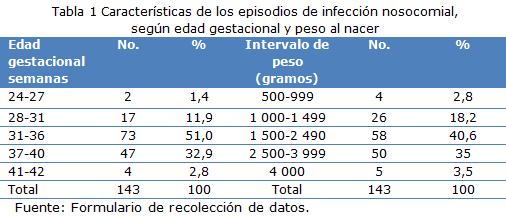
Results: The most affected neonates with healthcare-associated infection were those of gestational age between 31-36 weeks, weight 1500-2499 grams, delivery via cesarean section. As maternal factors urinary tract infection / vaginosis and neonatal prematurity followed by the epicutaneous catheter; regarding the location, the respiratory infection with the highest number of cases and the Gram negative germs the Enterobacter gergoviae with the highest incidence.
Conclusions: Both the modification and the knowledge of the risk factors will be favorable impacts for their reduction.
DeCS: CROSS INFECTION; NEONATOLOGY; INFANT, NEWBORN; NEONATAL SEPSIS; RISK FACTORS.
Downloads
References
1. Corral Pagan MT. Infecciones asociadas a la asistencia sanitaria en el servicio de Neonatología. Hospital Pediátrico. Holguín. 2018-2021 [tesis]. Holguín: Universidad de Ciencias Médicas; 2021 [citado 20 Nov 2022]. Disponible en: https://tesis.hlg.sld.cu/downloads/2275/TESIS%20MARIA%20TERESA.pdf
2. Cortés JS, Fernández Cruz LX, Beltrán Zúñiga E, Narváez CF, Fonseca-Becerra CE. Sepsis neonatal: aspectos fisiopatológicos y biomarcadores. MÉD UIS [Internet]. 2019 [citado 16 May 2022];32(3):35-47. Disponible en: http://www.scielo.org.co/pdf/muis/v32n3/1794-5240-muis-32-03-35.pdf
3. Mendoza Reyes KE, Díaz Castro A. Perfil clínico epidemiológico de neonatos con infección asociada a la atención sanitaria en hospital especializado. Alerta [Internet]. 2022 [citado 20 Nov 2022];5(1):17-25. Disponible en: http://portal.amelica.org/ameli/journal/419/4192878004/4192878004.pdf
4. Blengio A, Couto E, Cordobez R, Vezzaro V, Braz J, Dendi Á, et al. Infecciones intrahospitalarias por estafilococo coagulasa negativo en una unidad de neonatología. Arch Pediatr Urug [Internet]. 2021 [citado 21 Sep 2022];92(2):e212. Disponible en: http://www.scielo.edu.uy/pdf/adp/v92n2/1688-1249-adp-92-02-e212.pdf
5. Barreto González OJ, Baloa Tovar DC, García León MM. Sepsis neonatal epidemiología. Rev Digital Postgrado [Internet]. 2020 [citado 17 Mar 2022];9(1). Disponible en: https://docs.bvsalud.org/biblioref/2020/04/1053027/17888-144814488107-1-pb.pdf
6. Echeverría Rendón JR, Medina Herrera GA, Aspiazu Echeverría AG, Segovia Orozco AM. Características clínicas y epidemiológicas de la sepsis neonatal en un hospital pediátrico. Universidad, Ciencia y Tecnología [Internet]. 2019 [citado 17 Mar 2022];(1):53-8. Disponible en: https://uctunexpo.autanabooks.com/index.php/uct/article/download/197/270
7. Arias-Arellano S, Cáceres-Aucatoma F, Geyson D, Segarra-Galarza K. Factores de riesgo asociados a sepsis neonatal tardía Factores de riesgo asociados a sepsis neonatal tardía. Rev Med Inst Mex Seguro Soc [Internet]. 2019 [citado 12 Jun 2022];57(4):226-31. Disponible en: https://www.redalyc.org/journal/4577/457762844006/html/
8. Di Marco Yohanny M, Vargas Rodríguez E. Características clínicas y epidemiológicas de la sepsis neonatal en la unidad de cuidados intensivos polivalente. Salud Arte y Cuidado [Internet]. 2021 [citado 20 Feb 2022];14(1):19-24. Disponible en: https://revistas.uclave.org/index.php/sac/article/view/4044
9. Navarro Calvo R, Jiménez Ramos I, Navarro Torres M, Dácil Lorenzo Ramírez M, Caballero Casanova Y. Infecciones relacionadas con la asistencia sanitaria en neonatos, un gran problema para los más pequeños. Rev Sanitaria de Investigación [Internet]. 2021 Jun [citado 13 May 2022]. Disponible en: https://revistasanitariadeinvestigacion.com/infecciones-relacionadas-con-la-asistencia-sanitaria-en-neonatos-un-gran-problema-para-los-mas-pequenos/
10. Del Moral T. Infecciones nosocomiales en recién nacidos prematuros, ¿hacia dónde vamos? An Pediatr [Internet]. 2019 Jul [citado 12 Mar 2022];91(1):1-2. Disponible en: https://www.analesdepediatria.org/es-infecciones-nosocomiales-recien-nacidos-prematuros-articulo-S1695403319301419
11. Aríz Milián OC, Clemades Méndez AM, Faure Guerra Y, Pérez Martínez Y, García Benavides N, Mederos Cabana Y. Sepsis neonatal de inicio precoz en una unidad de cuidados neonatales: gérmenes asociados. Acta médica del centro [Internet]. 2019 [citado 23 Oct 2022];13(2). Disponible en: https://revactamedicacentro.sld.cu/index.php/amc/article/view/932/1284
12. Pérez Acevedo LC, Rodríguez Cobas G, Corredera Fernández R. Principales marcadores de sepsis neonatal precoz. Cibamanz [Internet]. 2021 [citado 18 May 2022]. Disponible en: https://cibamanz2021.sld.cu/index.php/cibamanz/cibamanz2021/paper/viewFile/794/493
13. Ostia-Garza PJ, Salzar-Espino B. Frecuencia de factores relacionados con sepsis neonatal. Perinatol Reprod Hum [Internet]. 2021 Ene-Abr [citado 28 Oct 2022];35(1). Disponible en: https://www.scielo.org.mx/scielo.php?script=sci_arttext&pid=S0187-53372021000100003
14. Ramos Salinas BMG. Características clínicas y epidemiológicas de sepsis neonatal en recién nacidos del hospital Hipólito Unanue de Tacna, 2016-2020 [tesis]. Tacna: Universidad Nacional Jorge Basadre Grohmann; 2021 [citado 15 Feb 2022]. Disponible en: http://repositorio.unjbg.edu.pe/bitstream/handle/UNJBG/4283/1948_2021_ramos_salinas_bmg_facs_medicina_humana.pdf?sequence=1&isAllowed=y
15. Apaza Maquera V, Ticona Rendón M. Incidencia y complicaciones del recién nacido gemelar. Revista Médica Basadrina [Internet]. 2021 [citado 15 Feb 2022];15(3):52-9. Disponible en: https://revistas.unjbg.edu.pe/index.php/rmb/article/view/1154
16. Ferrer Montoya R, Montero Aguilera A, Pérez Dajaruch MA, Green Rutan M,
Cedeño Escalona T. Factores de riesgo materno y neonatal en la infección probada de inicio precoz en pretérminos. Multimed [Internet]. 2020 Sep-Oct [citado 12 Ene 2022];24(5). Disponible en: http://scielo.sld.cu/scielo.php?script=sci_arttext&pid=S1028-48182020000501163
17. Lozada Castro JI, Paredes Cabay DG. Prevención y factores de riesgo asociados a sepsis neonatal temprana. Hospital Carlos Andrade Marín, 2021 [tesis]. Riobamba: Universidad Nacional de Chimborazo; 2022 [citado 15 Nov 2022]. Disponible en:
18. Guerrero-Cruz A, Fernández-Chacón A, González-Lorenzo RJ, Machado-Díaz MA, Pequeño Rondón MM. Factores de riesgo de infección neonatal precoz en pacientes atendidos en un hospital general. Rev electrón Dr. Zoilo E. Marinello Vidaurreta [Internet]. 2020 Mar-Abr [citado 15 Nov 2022];45(2). Disponible en: https://revzoilomarinello.sld.cu/index.php/zmv/article/view/2018/pdf_668
19. Pérez González CE, Ramírez Morales HA. Caracterización clínica de sepsis neonatal en el hospital Teodoro Maldonado Carbo [tesis]. Guayaquil: Universidad de Guayaquil; 2020 [citado 19 Jul 2022]. Disponible en: http://repositorio.ug.edu.ec/bitstream/redug/52530/1/CD-3304-PEREZ%20GONZALEZ%20RAMIREZ%20MORALES.pdf
20. Penagos-Tascón L, Atehortúa-Baena P, Rodríguez-Padilla LM, Hoyos-Orrego A. Características epidemiológicas, clínicas y microbiológicas de la infección del tracto urinario neonatal en un hospital en Medellín, 2013-2017. Iatreia [Internet]. 2022 [citado 19 Jul 2022];35(1):11-20. Disponible en: https://www.redalyc.org/journal/1805/180571097003/html/
21. López OJ, Buriticá HM. Letalidad por sepsis neonatal, factores de riesgo y características microbiológicas. Andes pediatr [Internet]. 2021 Oct [citado 22 Ago 2022];92(5). Disponible en: https://www.scielo.cl/scielo.php?script=sci_arttext&pid=S2452-60532021000500690
22. Burga-Montoya G, Luna-Muñoz C, Correa López L. Factores de riesgo asociados a sepsis neonatal temprana en prematuros de un Hospital Nacional Docente Madre Niño, 2017. Rev Fac Med Hum [Internet]. 2019 Jul-Sep [citado 23 May 2022];19(3). Disponible en: http://www.scielo.org.pe/scielo.php?script=sci_arttext&pid=S2308-05312019000300006
Published
How to Cite
Issue
Section
License
Copyright (c) 2023 Iluminada Menéndez-Placeres, Odalys Irmina Rodríguez-Heredia, Geidy Martín-Díaz, Néstor Navarro-Vega, Emirelys Yusmara Rodríguez-Aguiar, Yunaika Jacob-Pérez

This work is licensed under a Creative Commons Attribution-NonCommercial 4.0 International License.
Copyright: Camagüey Medical Archive Magazine, offers immediately after being indexed in the SciELO Project; Open access to the full text of the articles under the principle of making available and free the research to promote the exchange of global knowledge and contribute to a greater extension, publication, evaluation and extensive use of the articles that can be used without purpose As long as reference is made to the primary source.
Conflicts of interest: authors must declare in a mandatory manner the presence or not of conflicts of interest in relation to the investigation presented.
(Download Statement of potential conflicts of interest)
The Revista Archivo Médico de Camagüey is under a License Creative Commons Attribution-Noncommercial-No Derivative Works 4.0 International (CC BY 4.0).
This license allows others to distribute, to mix, to adjust and to build from its work, even for commercial purposes, as long as it is recognized the authorship of the original creation. This is the most helpful license offered. Recommended for maximum dissemination and use of licensed materials. The full license can be found at: https://creativecommons.org/licenses/






 22 julio 2025