

Evaluation of the national program of infections associated with health care in the Intensive Care service
Abstract
Introduction: Infections associated with health care are accompanied by high morbidity and mortality rates, which translates into an increase in hospital days and care costs, which constitute a negative event for the patient and the institution.
Objective: To evaluate the national program for the prevention and control of infections associated with health care in the Multipurpose Intensive Care Service of the Eduardo Agramonte Piña Provincial Pediatric Hospital, according to indicators of structure, process and results.
Methods: A cross-sectional investigation was carried out on health systems and services. The universe of study was made up of all the hospitals in the Camagüey province with more than 100 beds and the sample at the discretion of the Pediatric Polyvalent Intensive Care Service. The primary data source was made up of a questionnaire applied by the authors.
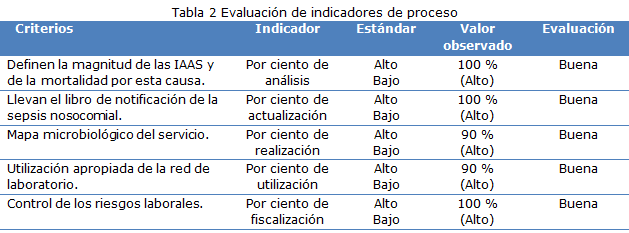
Results: Of the ten structure indicators, nine with a good evaluation, of the five process indicators, all received a good evaluation, as well as the seven indicators of the results dimension. A total of 22 parameters, of which 21 evaluated as good and one evaluated as bad.
Conclusions: The final evaluation of the program for the prevention and control of infections associated with health care was satisfactory because its three dimensions obtained adequate results.
DeCS: HOSPITAL INFECTION CONTROL PROGRAM; INTENSIVE CARE UNITS; CROSS INFECTION; QUALITY INDICATORS, HEALTH CARE; SECONDARY CARE.
Downloads
References
1. Ramos-Cevallo JF, Tomás-Cordero LA, Tomás-Fernández AO,
Fiallos-Mayorga TJ. Infecciones Asociadas Atención en Salud. Artículo de Revisión.
Dom Cien [Internet]. 2022 Abr-Jun [citado 15 Ene 2023];8(2). Disponible en: https://www.dominiodelasciencias.com/ojs/index.php/es/article/view/2677
2. Arrate Lobaina L, Morales Lobaina CE, Cantillo Navarro LA, Despaigne Bonne J, Heredia Leal IM. Características clínico-epidemiológicas de pacientes con infecciones intrahospitalarias en un servicio de medicina interna de Santiago de Cuba. Medisan [Internet]. 2022 [citado 22 Feb 2023];26(2). Disponible en: https://medisan.sld.cu/index.php/san/article/view/4062/2656
3. Manzano Serrano M, Bordies Lavin YL, Tase Rodríguez AK, González Soler JB, García Raventos R, Manzano Serrano PA. Infección nosocomial en Cuidados Intensivos del Hospital Universitario Clínico Quirúrgico Comandante Faustino Pérez Hernández, de Matanzas. Rev méd electrón [Internet]. 2021 Jul-Ago [citado 20 Dic 2022];43(4). Disponible en: http://scielo.sld.cu/scielo.php?script=sci_arttext&pid=S1684-18242021000401029
4. Pérez Verea L, Fernández Ferrer A, Olivera Reyes Y, Puig Miranda Y, Rodríguez Méndez A. Infecciones nosocomiales y resistencia antimicrobiana. Rev cuban med int emerg [Internet]. 2019 [citado 18 Oct 2022];18(1). Disponible en: https://revmie.sld.cu/index.php/mie/article/view/475/html_191
5. Camejo Serrano YA, Elias González JA, Morales Torres G, Rivera Morell M, Licea Castellano L. Factores de riesgo de infecciones adquiridas en Unidad de Cuidados Intensivos Pediátricos de Bayamo. 2018-2019. Multimed [Internet]. 2020 Mar-Abr [citado 29 Oct 2021];24(2). Disponible en: https://revmultimed.sld.cu/index.php/mtm/article/view/1904/1922
6. Sociedad Española de Enfermedades Infecciosas y Microbiología Clínica. Las enfermedades infecciosas en 2050. Cómo serán las enfermedades infecciosas en 30 años [Internet]. España: SEIMC; 2022 [citado 12 Feb 2023]. Disponible en: https://seimc.org/contenidos/documentoscientificos/seimc-LasEnfermedadesInfecciosasen2050.pdf
7. Pérez Abreu MR, Gómez Tejeda JJ, Cruz Díaz J, Diéguez Guach RA. Infecciones nosocomiales en la Unidad de Cuidados Intensivos del Hospital General de Gibara: 2013-2018. Correo cient méd [Internet]. 2021 [citado 14 Nov 2022];25(3). Disponible en: https://revcocmed.sld.cu/index.php/cocmed/article/view/3776/1971
8. Betancourt Betancourt GJ, Culay Pérez A, Betancourt Reyes GL. Comportamiento de las infecciones nosocomiales en una unidad de cuidados intensivos. Rev cuban med int emerg [Internet]. 2021 [citado 20 Dic 2022];20(2):e768. Disponible en: https://www.medigraphic.com/pdfs/revcubmedinteme/cie-2021/cie212e.pdf
9. Duany Badell LE, Suárez del Villar Seuret S, Cantero Martínez T, Águila Toledo MC, Hernández Malpica S, Hernández Monsón V. Características clínico-epidemiológicas de pacientes notificados con infección intrahospitalaria en Unidad de Cuidados Intensivos pediátricos. Cienfuegos, 2015-2019. Medisur [Internet]. 2022 [citado 16 Dic 2022];20(1). Disponible en: https://medisur.sld.cu/index.php/medisur/article/view/5014/3691
10. Falcón Fariñas IN, de Dios Martínez A, Macías Llanes ME. Procedimiento para evaluar programas de salud desde un enfoque gerencial. Rev retos [Internet]. 2021 [citado 15 Feb 2022];15(Suppl 1). Disponible en: http://scielo.sld.cu/scielo.php?script=sci_arttext&pid=S2306-91552021000300187
11. Morales Cedeño I. Evaluación del Programa Nacional de las Infecciones Asociadas con la Asistencia Sanitaria, año 2019 [tesis]. Camagüey: Universidad de Ciencias Médicas Carlos J Finlay; 2020.
12. Sabina Milián LM. Evaluación del Programa Nacional de Infecciones Asociadas con la Asistencia Sanitaria. Servicio de Terapia Intensiva Polivalente Pediátrica, año 2019 [tesis]. Camagüey: Universidad de Ciencias Médicas Carlos J Finlay; 2020.
13. Morales Torres G, Camejo Serrano YA, Elías González JA, Domínguez Fonseca JJ, Tamayo Vázquez J. Morbilidad e indicadores hospitalarios en la Unidad de cuidados intensivos pediátricos de Bayamo, 2008-2018. Multimed [Internet] 2020 [citado 16 Jul 2021];24(2). Disponible en: https://revmultimed.sld.cu/index.php/mtm/article/view/1907
14. Agüero Milanés AM, Infante Rondón KZ, Delgado Llorca FE. Infecciones nosocomiales por bacterias gram negativas y estadía prolongada en cuidados intensivos pediátricos. Rev habanera cienc méd [Internet]. 2021 May-Jun [citado 26 Mar 2022];20(3):e3608. Disponible en: https://www.redalyc.org/articulo.oa?id=180467416007
15. Barzallo Ochoa TP. Prevalencia y factores asociados de las infecciones asociadas a la atención de la salud en el servicio de pediatría y unidad de cuidados intensivos pediátricos del Hospital Vicente Corral Moscoso, Mayo 2018-Octubre 2019 [tesis]. Cuenca: Universidad de Cuenca; 2020 [citado 12 Oct 2022]. Disponible en: http://dspace.ucuenca.edu.ec/bitstream/123456789/34370/1/Tesis.pdf
16. Rodríguez Álvarez VM, Hernández Seara A. Infecciones asociadas a la atención sanitaria en el Instituto Nacional de Angiología y Cirugía Vascular. Rev cuba angiol cir vasc [Internet]. 2021 [citado 25 Nov 2022];22(2). Disponible en: https://revangiologia.sld.cu/index.php/ang/article/view/275/318
17. Meza Conforme JI. Bioseguridad en la prevención de infecciones asociadas a la atención en salud en el área de emergencia del Centro de Salud tipo C, Augusto Egas [tesis]. Ecuador: Pontifica Universidad Católica del Ecuador; 2020 [citado 18 May 2022]. Disponible en: https://repositorio.pucese.edu.ec/bitstream/123456789/2409/1/MEZA%20CONFORME%20JESSENIA%20ISABEL.pdf
18. Yanes Macías JC, Mayón Moya I, Pérez Carrodeguas DE, Gómez Morejón A, Osés Díaz H, Díaz Ceballos JC. Factores asociados a las infecciones relacionadas con la asistencia sanitaria en la unidad de cuidados intensivos pediátricos. Rev cuban pediatr [Internet]. 2022 [citado 18 May 2022];94(4). Disponible en: https://revpediatria.sld.cu/index.php/ped/article/view/2001
19. Hernández Faure C, González Treasure A, González Rodríguez I, de la Cruz Vázquez R. Conocimientos, actitudes y prácticas relacionadas con las infecciones intrahospitalarias en Nicaragua. Rev inf cient [Internet]. 2019 Ene-Feb [citado 26 Oct 2022];98(1). Disponible en: https://dialnet.unirioja.es/descarga/articulo/6998218.pdf
20. Perozo Mena A, Castellano González MJ, Gómez Gambo LP. Infecciones asociadas a la atención en salud. Enferm Inv [Internet]. 2020 Mar-May [citado 25 Sep 2021];5(2). Disponible en: https://www.google.com/url?sa=t&rct=j&q=&esrc=s&source=web&cd=&cad=rja&uact=8&ved=2ahUKEwic1cnX5JD_AhUdSTABHcvSCikQFnoECAkQAQ&url=https%3A%2F%2Frevistas.uta.edu.ec%2Ferevista%2Findex.php%2Fenfi%2Farticle%2Fdownload%2F877%2F830%2F&usg=AOvVaw1nMfqAX51knS5AQXdwWa2c
21. Molina de Rivera LV, Zetino SV. Componentes de programas de prevención y control de infecciones asociadas a atención en salud, hospitales generales y médicos quirúrgicos ISSS [tesis]. El Salvador: Universidad de El Salvador; 2021 [citado 26 Oct 2022]. Disponible en: https://ri.ues.edu.sv/id/eprint/27550/1/323-11106564.pdf
Published
How to Cite
Issue
Section
License
Copyright (c) 2022 Geidy Martin-Díaz, Odalys Irmina Rodríguez-Heredia, Iluminada Menéndez-Placeres, Yunielkys Marrero-Alvarez, Eylen Viviana Ferrer-Yero

This work is licensed under a Creative Commons Attribution-NonCommercial 4.0 International License.
Copyright: Camagüey Medical Archive Magazine, offers immediately after being indexed in the SciELO Project; Open access to the full text of the articles under the principle of making available and free the research to promote the exchange of global knowledge and contribute to a greater extension, publication, evaluation and extensive use of the articles that can be used without purpose As long as reference is made to the primary source.
Conflicts of interest: authors must declare in a mandatory manner the presence or not of conflicts of interest in relation to the investigation presented.
(Download Statement of potential conflicts of interest)
The Revista Archivo Médico de Camagüey is under a License Creative Commons Attribution-Noncommercial-No Derivative Works 4.0 International (CC BY 4.0).
This license allows others to distribute, to mix, to adjust and to build from its work, even for commercial purposes, as long as it is recognized the authorship of the original creation. This is the most helpful license offered. Recommended for maximum dissemination and use of licensed materials. The full license can be found at: https://creativecommons.org/licenses/






 22 julio 2025