

Creatinine, potassium and glycemia values as predictors of adverse events in acute coronary syndrome
Abstract
Introduction: In recent years, the definition of acute coronary syndrome has encompassed the different forms of presentation of acute ischemic heart disease. Despite the current therapeutic possibilities, it still presents a high morbidity and mortality and there are no laboratory tools to suspect complications early.
Objective: To determine the value of the changes in the concentration of creatinine, potassium and glycemia as predictors of adverse events of acute coronary syndrome in patients admitted to Hospital Universitario Manuel Ascunce Domenech in the period from October 2017 to October 2018.
Methods: A analytical cohort study. The sample consisted of 124 patients. A form was made where the data were collected from the medical records, the variables were: age groups, sex, skin color, diagnosis, adverse event, creatinine, potassium and glycemia.
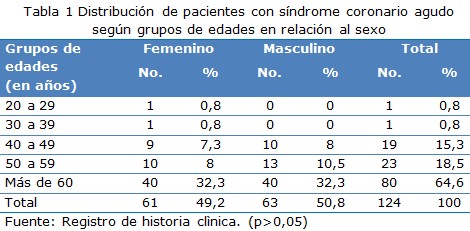
Results: The age group over 60 years old, male sex and white skin color predominated. The main adverse events were arrhythmias and left ventricular dysfunction. Elevated creatinine was associated with left ventricular dysfunction with heart failure and acute pulmonary edema, hyperkalemia was associated with potentially fatal arrhythmias that degenerated into asystole arrest and death. Hypokalemia was associated with arrhythmias and hyperglycemia with the recurrence of the ischemic episode.
Conclusions: All the patients with normal values of creatinine, potassium and glycemia without complications and their usefulness as predictors of adverse events of acute coronary syndrome was demonstrated.
DeCS: ACUTE CORONARY SYNDROME; CREATININE; INDICATORS OF MORBIDITY AND MORTALITY; CLINICAL DECISION RULES; LABORATORY CRITICAL VALUES.
Downloads
References
1. Instituto de Aragonés de Ciencias de la Salud. El enfermo crítico. Cardiovascular. Síndrome Coronario Agudo y sus complicaciones [Internet]. Aragón, España: Instituto de Aragonés de Ciencias de la Salud; 2012 [citado 11 Mar 2018]. Disponible en: http://www.icsaragon.com/cursos/enfermo-critico/pdf/02-07.pdf
2. Steg G, James SK, Atar D, Badano LP, Blomstrom Lundqvist C, Borger MA, et al. Guía de práctica clínica de la ESC para el manejo del infarto agudo de miocardio en pacientes con elevación del segmento ST. Rev Esp Cardiol [Internet]. 2013 Ene [citado 11 Feb 2018];66(1):53. Disponible en : https://www.revespcardiol.org/es-guia-practica-clinica-esc-el-articulo-S0300893212006355
3. López Ramírez M, Ramos Emperador C, Gómez Fernández M, Peña Fernández NE, Fusté Pedroso W, Tamargo Barbeito TO, et al. Factores relacionados con la muerte súbita en pacientes con infarto agudo de miocardio. CorSalud [Internet]. 2017 Abr-Jun [citado 11 Feb 2018];9(2). Disponible en : http://scielo.sld.cu/scielo.php?script=sci_arttext&pid=S2078-71702017000200003
4. Zeymer U, Bueno H, Granger CB, Hochman J, Huber K, Lettino M, et al. Acute Cardiovascular Care Association position statement for the diagnosisand and treatment of patients with acute myocardial infarction complicated by cardiogenic shock: A document of the Acute Cardiovascular Care Association of the European Society of Cardiology. Eur heart J Acute Cardiovasc care [Internet]. 2020 Mar [citado 27 Abr 2021];9(2):183-97. Disponible en:
https://academic.oup.com/ehjacc/article/9/2/183/5933392
5. Ministerio de Salud Pública. Anuario Estadístico de Salud 2019 [Internet]. La Habana: Dirección de Registros Médicos y Estadísticas de Salud; 2020 [citado 13 Oct 2021]. Disponible en: https://files.sld.cu/bvscuba/files/2020/08/Anuario-Estadistico-Espa%C3%B1ol-2020-Definitivo.pdf
6. Martín García A. Estudio de marcadores bioquímicos de interés en el diagnóstico y pronóstico del síndrome coronario agudo [tesis doctoral]. Madrid, España: Universidad Complutense de Madrid; 2009 [citado 11 Mar 2018]. Disponible en: https://eprints.ucm.es/id/eprint/10752/1/T31857.pdf
7. Moreno Alatorre MA. Valoración cardiovascular preoperatoria [Internet]. México: Anestesiología Mexicana en Internet; 2012 [citado 11 Mar 2018]. Disponible en: http://www.anestesia.com.mx/art32.html
8. Santamaría Olmo R, Gorostidi Pérez M. Síndrome Cardiorrenal. Nefrología al día [Internet]. España: Sociedad Española de Nefrología; ©2019 [actualizado 10 Jul 2015; citado 12 Feb 2019]; [aprox. 4 pantallas]. Disponible en: http://devawsnad.elsevier.es/es-articulo-sindrome-cardiorrenal-87
9. Bohorquez Rivero JJ, Restom Arrieta J, Pineda Paternina M, Cantillo García K, Montoya Jaramillo M. Concepciones Diagnósticas y Manejo de Hiperkalemia en el Paciente con Enfermedad Renal Crónica: Revisión a Propósito de un Caso Clínico. Colombia: Archivos de Medicina. 2020;16(2):1. doi:10.3823/1424.
10. Vicent Alaminos ML. Nuevo objetivo terapéutico en la IC: conseguir y mantener la normopotasemia. Cardiología hoy [Internet]. España: Sociedad Española de Cardiología; ©2019 [citado 15 Feb 2019]. Disponible en: https://secardiologia.es/multimedia/blog/9446-nuevo-objetivo-terapeutico-ic-conseguir-y-mantener-normopotasemia
11. Alemán Sánchez JJ, Álvarez Guisasola F, Artola Menéndez S, Ávila Lachica I, Barrot de la Puente J, et al. Guía de actualización en diabetes mellitus tipo 2 [Internet]. España: Fundación redGDPS; 2017 [citado 18 Mar 2019]. Disponible en: http://redgdps.org/gestor/upload/GUIA2016/Guia_Actualizacion_2016.pdf
12. Santos Medina M, Parra Siscar JL, Rabert Fernández AR, Góngora Cortés D. Factores predictivos de eventos cardiacos adversos mayores en pacientes con infarto agudo de miocardio. Rev cuba cardiol cir cardiovasc [Internet]. 2018 [citado 15 Feb 2019];24(3). Disponible en: http://www.revcardiologia.sld.cu/index.php/revcardiologia/article/view/768/html
13. Abrams CS, Accurso FJ, Afdhal NH, Akin C, Aksamit AJ, Al-Awqati Q, et al. Goldman’s Cecil medicine. 25ª ed. Philadelphia: Elsevier; 2016.
14. Martins H, Monteiro S, Gonçalves F, Monteiro P, Pêgo M. Glucemia en los síndromes coronarios agudos. ¿Hasta qué nivel debe reducirse? Rev Esp Cardiol [Internet]. 2015 Ene [citado 11 Feb 2019];68(1):25-30. Disponible en: https://www.revespcardiol.org/es-glucemia-sindromes-coronarios-agudos-hasta-articulo-S0300893214002152
15. Jameson JL, Fauci AS, Kasper DL, Hauser SL, Longo DL, Loscalzo J, et al. Harrison. Pincipios de Medicina Interna. 20a ed. México: McGraw-Hill Education; 2018.
16. Noya Chaveco ME, Moya Gonzñalez NL, LLamos Sierra N, Morales Larramendi R, Cardona Garbey DL, Filiú Ferrera JL, et al. Roca Goderich. Temas de Medicina Interna. 5 ª ed. Vol. 2. La Habana: Editorial Ciencias Médicas; 2017.
17. Arjona Rodríguez IA. Cardiopatía isquémica. En: Vicente Peña E, editor. Medicina interna dignóstico y tratamiento. 2ª ed. La Habana: Editorial Ciencias Médicas; 2016. p. 89-102.
18. Shimada M, Dass B, Ahsan Ejaz A. Evaluación del aumento de creatinina. BMJ Best Practice [Internet]. 2018 Nov [citado 21 Ene 2019];68(8):[aprox. 10 p.]. Disponible en: https://bestpractice.bmj.com/topics/es-es/935
19. Aguilar Florit J, Rodríguez Padial L. Cardiovascular. En: Julián Jiménez A, editor. Manual de Protocolos y Actuación en Urgencias. 4ª ed. España: Editorial Sanidad y Ediciones; 2014. p. 223-351.
20. Mark Sintek A, Philip Barger M. Cardiopatía isquémica. En: Pavan Bhat MD, editor. Manual Washington de terapéutica médica. 35ª ed. Washington: Editorial Wolters Kluwer; 2017. p. 89-118.
21. Castro Martínez MG, Godínez Gutiérrez SA, Liceaga Craviotto MA, Alexanderson Rosas G, Cabrera Jardines R, Carrillo Esper R, et al. Manejo de la hiperglucemia en el paciente hospitalizado. Rev Med Int Mex [Internet]. 2012 [citado 11 Mar 2018];28(2):124-53. Disponible en: https://www.medigraphic.com/pdfs/medintmex/mim-2012/mim122f.pdf
22. Di Somma S, Magrini L. Tratamiento farmacológico en la insuficiencia cardiaca aguda. Rev Esp Cardiol [Internet]. 2015 Ago [citado 21 Ene 2021];68(8):706-13. Disponible en:
23. Nuñez Gil IJ. Tratamiento antiagregante en diabéticos con síndrome coronario agudo [Internet]. Madrid, España: Sociedad Española de Cardiología; 2019 [citado 15 Feb 2019]. Disponible en: https://secardiologia.es/blog/3236-tratamiento-antiagregante-en-diabeticos-con-sindrome-coronario-agudo
Published
How to Cite
Issue
Section
License
Copyright (c) 2022 Ana María Marrero-Fernández, Angelina Leyva-Diviú, Cira Cecilia León-Ramentol, Oscar Jesús Cebrian-Rodríguez, Ana Isabel Carbajales-León, Yamelis Umpierre-Martinez

This work is licensed under a Creative Commons Attribution-NonCommercial 4.0 International License.
Copyright: Camagüey Medical Archive Magazine, offers immediately after being indexed in the SciELO Project; Open access to the full text of the articles under the principle of making available and free the research to promote the exchange of global knowledge and contribute to a greater extension, publication, evaluation and extensive use of the articles that can be used without purpose As long as reference is made to the primary source.
Conflicts of interest: authors must declare in a mandatory manner the presence or not of conflicts of interest in relation to the investigation presented.
(Download Statement of potential conflicts of interest)
The Revista Archivo Médico de Camagüey is under a License Creative Commons Attribution-Noncommercial-No Derivative Works 4.0 International (CC BY 4.0).
This license allows others to distribute, to mix, to adjust and to build from its work, even for commercial purposes, as long as it is recognized the authorship of the original creation. This is the most helpful license offered. Recommended for maximum dissemination and use of licensed materials. The full license can be found at: https://creativecommons.org/licenses/





 22 julio 2025