

Diagnosis of oral hygiene in patients with orthodontic appliances
Abstract
Background: adequate oral hygiene is necessary in patients who wear orthodontic appliances.
Objective: to identify knowledge, attitudes, practices and oral hygiene in patients with orthodontic appliances.
Methods: a study with a non-experimental, descriptive and cross-sectional design was carried out in the Provincial Teaching Dentistry Clinic of Sancti Spíritus in the period between September 2018 and July 2019. Methods from the theoretical, empirical (survey, interview and observation) and statistical level were used. The population consisted of 30 patients from this institution with orthodontic treatment. The measured variables were: age and sex of the patient, type of orthodontic appliance, level of knowledge about oral health, attitude and oral hygiene practices of the patient, frequency, form and efficiency of tooth brushing, as well as brushing or not after the ingestion of sugary foods.
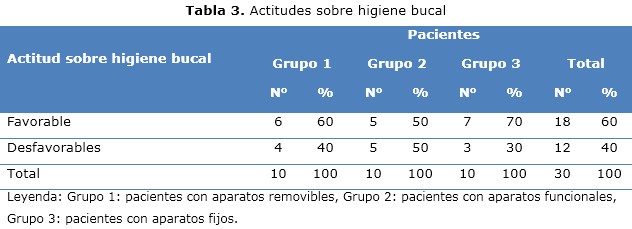
Results: 100% of the patients presented poor knowledge about oral health and unfavorable practices, although favorable attitudes were found in 63.3% of the patients. Regular oral hygiene predominated in the population studied before starting treatment and after installing the appliances, similarly in the groups with removable, functional and fixed appliances.
Conclusions: the studied population patients need education to acquire sufficient knowledge to maintain healthy attitudes, practices and oral hygiene.
DeCS: ORAL HYGIENE; ORTHODONTICS; TOOTHBRUSHING; HEALTH KNOWLEDGE, ATTITUDES, PRACTICE; ORTHODONTIC APPLIANCES.
Downloads
References
1. Otaño Lugo R. Ortodoncia [Internet]. La Habana: Ecimed; 2014 [citado 14 Oct 2020]. Disponible en: http://www.bvs.sld.cu/libros_texto/ortodoncia/completo_ortodoncia.pdf
2. Quintero AM, García C. Control de la higiene oral en los pacientes con ortodoncia. Rev nac odontol [Internet]. 2014 [citado 30 Mar 2020];9. Disponible en: http://198.46.134.239/index.php/od/article/view/430
3. Gacitúa Cártes P, Werlinger Cruces F, Ríos Erazo M, Álvarez Palacios E. Satisfacción del uso de brackets metálicos en relación a higiene oral, confort y autopercepción estética. Rev Cubana Estomatol [Internet]. Mar 2016 [citado 30 Mar 2020];53(1):28-42. Disponible en: http://scielo.sld.cu/scielo.php?script=sci_arttext&pid=S0034-75072016000100005&lng=es
4. Behrents RG. Oral higiene during orthodontic treatment: Offerse or defense? Am J.Orthood Dentofacial Orthop [Internet]. 2016 [citado 27 Mar 2020];149(3):303-4. Disponible en: https://www.journals.elsevier.com/seminars-in-orthodontics
5. Moosa Yousuf, Han Ling Na, Safdar Jawad, Sheikh Omair Ahmed, Pan Ya P. Periodontal status of Pakistani orthodontic patients. Braz oral res [Internet]. 2015 [citado 30 Mar 2020];29(1):1-5. Disponible en: http://www.scielo.br/scielo.php?script=sci_arttext&pid=S1806-83242015000100285&lng=en
6. Raszl Henrique P, De Macedo Máximo P, Paschoal Silva ML, Roberto Cortelli J, Cavalca Cortelli S. Influência dos braquetes convencionais ou autoligados nos parâmetros periodontais–revisão de literatura. Braz J Periodontol–Março [Internet]. 2018 [citado 23 Ene 2020];28(1):28-34. Disponible en: http://revistasobrape.com.br/arquivos/2018/marco/REVPERIO_MAR%C3%87O_2018_PUBL_SITE_PAG-28_A_34-13-04-2018.pdf
7. Premchind TK, Agarwal A, Kumar R. Role of Biofilm and its Effects in Orthodontic Treatment. Journal of Orofacial & Health Sciences [Internet]. 2019 [citado 23 Ene 2019];10(1):13-21. Disponible en: http://www.indianjournals.com/ijor.aspx?target=ijor:johs&volume=10&issue=1&article=003
8. Attin R. Caries Prevention in Orthodontics. Inf Orthod Kieferorthop [Internet]. 2016 [citado 17 Ene 2020];48(2):121-126. Disponible en: https://www.thieme-connect.com/products/ejournals/abstract/10.1055/s-0042-110013
9. Park KJ, Kroker T, Groß U, Zimmermann O, Krause F, Haak R, et al. Effectiveness of caries-preventing agents on initial carious lesions within the scope of orthodontic therapy. Korean J Orthod [Internet]. 2019 [citado 22 Jul 2020];49 (4):246-253. Disponible en: https://www.ncbi.nlm.nih.gov/pmc/articles/PMC6658901/.
10. Walsh LJ, Healey DL. Prevention and caries risk management in teenage and orthodontic patients. Australian Dental Journal [Internet]. 2019 [citado 23 Ene 2019];64(1):37-45. Disponible en:
https://onlinelibrary.wiley.com/doi/abs/10.1111/adj.12671
doi.org/10.1111/adj.12671
11. Sundararaj D, Venkatachalapathy S, Tandon A, Pereira A. Critical evaluation of incidence and prevalence of white spot lesions during fixed orthodontic appliance treatment: A meta-analysis. J Int Soc Prev Community Dent [Internet]. 2015 [citado 23 Ene 2019];5:433-439. Disponible en: https://www.ncbi.nlm.nih.gov/pubmed/26759794
12. Nieto Aguilar R, Serrato Ochoa D, Montaño Liévanos S, Loyola Rodríguez JP. Incidencia de lesión de mancha blanca en las clínicas de ortodoncia de la Universidad Michoacana en Morelia, Michoacán, México. Actualidad Médica [Internet]. 2018 [citado 23 Mar 2019];103(803):17-21. Disponible en: https://digibug.ugr.es/bitstream/handle/10481/52417/803_17.pdf?sequence=1&isAllowed=y
13. Pinto AS, Severo Alves L, Maltz M, Susin C, Zenkner JE. Does the Duration of Fixed Orthodontic Treatment Affect Caries Activity among Adolescents and Young Adults? Caries Res [Internet]. 2018 [citado 12 Apr 2019];52(6):463-467. Disponible en: https://doi.org/10.1159/000488209
14. Marín Carlos A. Importancia del control de placa bacteriana en el tratamiento ortodóncico. Rev Estomatología [Internet]. 2007 [citado 30 Mar 2019];15(1):24-28. Disponible en: http://revistas.univalle.edu.co/index.php/revista_estomatologia/article/view/5607
15. Pacho Saavedra JA, Rodríguez Patterson MC, Pichardo Pico M. Higiene bucal: su repercusión en pacientes con tratamientos ortodóncicos. Rev Cubana Estomatol [Internet]. Mar 2007 [citado 31 Mar 2020];44(1). Disponible en: http://scielo.sld.cu/scielo.php?script=sci_arttext&pid=S0034-75072007000100003&lng=es
16. Soto Ugalde A, Sexto Delgado N, Gontán Quintana N. Intervención educativa en salud bucal en niños y maestros. Medisur [Internet]. 2014 Feb [citado 2017 Mayo 08]; 12(1): 24-34. Disponible en: http://medisur.sld.cu/index.php/medisur/article/view/2571
17. Porcaro Bretas L, Esteves Rocha M, Santana Vieira M, Pérez Rodríguez AC. Fluxo salivar e capacidade tamponante da saliva como indicadores de susceptibilidade ? doença cárie. Pesq Bras Odontoped [Internet]. 2018 Dic [citado 16 May 2019]8(3):289–293. Disponible en: http://www.redalyc.org/articulo.oa?id=63711711005
18. López Pérez J, Jiménez González S, Pérez Ferrer MS. Propuesta de estrategia educativa sobre salud bucal en escolares. Escuela secundaria básica Amilka Cabral;2015. Disponible en: www.estomatologia2015.sld.cu/index.php/.../nov2015/paper/.../483
19. Hechavarría Martínez BO, Núñez Antúnez L, Pons Hechavarría LB, Núñez Almarales NI, Borges Llauger C. Componentes y determinantes del estado de salud bucal en pacientes de un consultorio médico de la familia. MEDISAN [Internet]. Jun 2017 [citado 20 Mar 2019]; 21(6):655-663. Disponible en: http://scielo.sld.cu/scielo.pHp?script=sci_arttext&pid=S1029-30192017000600003&lng=es
20. Alzoubi EE, Borg VT, Gatt G, Aguis AM, Attard N. The importance of oral health education in patients receiving orthodontic treatment. J Oral Res Rev [Internet]. 2019 [citado 08 Abr 2019];11(1):12-19. Disponible en: http://www.jorr.org/article.asp?issn=2249-4987;year=2019;volume=11;issue=1;spage=12;epage=19;aulast=M
DOI: 10.4103/jorr.jorr_24_18
21. Torres Gárriz L, López Otero E, Sardiñas Montero E. Intervención educativa para elevar los conocimientos y modificar hábitos sobre salud bucal en niños. MEDICIEGO [Internet]. 2013 [citado 09 May 2019];19(Supl.1). Disponible en: http://bvs.sld.cu/revistas/mciego/vol19_supl1_2013/articulos/t-1
Published
How to Cite
Issue
Section
License
Copyright (c) 2021 Lizandro Michel Pérez-García, Yadira Yanes-Ruiz, Delsa Elena Morgado-Marrero, Orlando Martín-Cárdenas, Rosa María García-López, Osvaldo Jiménez-Marín

This work is licensed under a Creative Commons Attribution-NonCommercial 4.0 International License.
Copyright: Camagüey Medical Archive Magazine, offers immediately after being indexed in the SciELO Project; Open access to the full text of the articles under the principle of making available and free the research to promote the exchange of global knowledge and contribute to a greater extension, publication, evaluation and extensive use of the articles that can be used without purpose As long as reference is made to the primary source.
Conflicts of interest: authors must declare in a mandatory manner the presence or not of conflicts of interest in relation to the investigation presented.
(Download Statement of potential conflicts of interest)
The Revista Archivo Médico de Camagüey is under a License Creative Commons Attribution-Noncommercial-No Derivative Works 4.0 International (CC BY 4.0).
This license allows others to distribute, to mix, to adjust and to build from its work, even for commercial purposes, as long as it is recognized the authorship of the original creation. This is the most helpful license offered. Recommended for maximum dissemination and use of licensed materials. The full license can be found at: https://creativecommons.org/licenses/






 22 julio 2025