

Clinical-epidemiological characterization of basal carcinoma
Abstract
Introduction: Basal cell carcinoma is a malignant neoplasm of the skin, representing 75-80 % of skin cancers worldwide.
Objective: To characterize the clinical and epidemiological variables in patients with basal cell carcinoma.
Methods: A descriptive, retrospective, longitudinal study was conducted to characterize the clinical and epidemiological variables of basal cell carcinoma at the Celia Sánchez Manduley Clinical Surgical Hospital, from January 2018 to December 2020. The universe consisted of 377 patients over 19 years of age, with clinical and histopathological diagnoses of basal cell carcinoma and cutaneous fototype I, II, III.
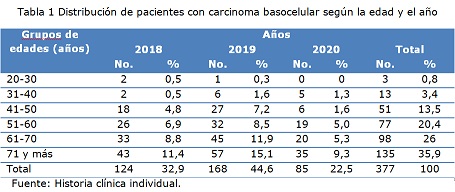
Results: Ages over 71 years were the predominant (63.4 %) 239 of the subjects had skin phototype II; while (61.8 %) 233 and (52.8 %) 199 had a personal and family history of basal carcinoma, respectively. 94.5 % of people reported being exposed to the sun. The (3.7 %) 114 of patients had baseline morpheiform carcinoma, the high-risk area was predominant in patients with this neoplasm
Conclusions: Basal cell carcinoma is a common condition in Manzanillo’s population and continues to be a challenge for the health system. It is very common in the elderly. Prolonged exposure to sunlight, as well as white skin and a personal and family history of basal cell carcinoma are the primary risk factors for the development of this cancer entity. The nodular clinical form and the undifferentiated histological variety are the most common.
DeCS: CARCINOMA, BASAL CELL/epidemiology; ADENOCARCINOMA; SKIN NEOPLASMS; RISK FACTORS; DERMATOLOGY.
Downloads
References
1. Acosta Medina D, Boyeros Fernández D, García López L. Caracterización clínica de pacientes con carcinoma basocelular. Medimay [Internet]. 2023 [citado 20 Mar 2024]; 30(3) :[aprox. 5 p.]. Disponible en: https://revcmhabana.sld.cu/index.php/rcmh/article/view/2046
2. Sánchez Linares V, Cifuentes Suarez JP, Martínez Cuervo JJ, Román Simón M, Pérez García C, Bello Rivero I. Carcinoma basocelular del rostro tratado con HeberFERON. Gac Méd Espirit [Internet]. 2019 [citado 20 Mar 2024]; 21(2): [aprox. 10 p.]. Disponible en: https://revgmespirituana.sld.cu/index.php/gme/article/view/1992
3. Alejandre Ovejero B, Garde Lecumberri C, García Martínez MÁ, Mirón Pozo B. Carcinoma basocelular perianal, una localización infrecuente. Cir Andal [Internet]. 2024[citado 20 Mar 2024]; 35(1). Disponible en: https://dialnet.unirioja.es/descarga/articulo/9314368.pdf
4. Vázquez Blanco E, Domínguez Moralobo RA, Zamora León I, Valerino Guzmán E, Vázquez Ortíz HJ. Caracterización clínica y epidemiológica del carcinoma basocelular en el Hospital Celia Sánchez Manduley, 2017- 2019. Rev Ciencias Médicas [Internet]. 2021 [citado 20 Mar 2024]; 25(5): e5053. Disponible en: http://revcmpinar.sld.cu/index.php/publicaciones/article/view/5053
5. Barcaui EO, Carvalho Pinares AC, Valiante PM, Piñeiro Maceira J, Baptista Barcaui C. High-frequency (22-MHz) ultrasound for assessing the depth of basal cell carcinoma invasion. Skin Res Technol [Internet]. 2021 [citado 20 Mar 2024]; 27(5):676-81. Disponible en: https://pubmed.ncbi.nlm.nih.gov/33404160/
6. González Moncayo JN, Ventosa Ruiz P, García Ruiz I. Sospecha ecográfica de carcinoma basocelular. A propósito de un caso. Rev Esp Podol [Internet]. 2023 [citado 20 Mar 2024]; 34(2):109-112. Disponible en: https://scielo.isciii.es/pdf/podologia/v34n2/2695-463X-podologia-34-02-109.pdf
7. Álvarez Castillo A, Rodríguez Alfaro JM, Salas Boza A. Revisión sistemática del carcinoma basocelular. Rev méd sinerg [Internet]. 2020 [citado 20 Mar 2024]; 5(5):e483. Disponible en: https://revistamedicasinergia.com/index.php/rms/article/view/483
8. Loizate Sarrionandia I, de la Rosa Fernández E, González Rodríguez J, Hernández Hernández MH, Pelegrina ME, Castro Tarruellab MV. Carcinoma basocelular en el Área Sur de Salud de Tenerife. Características clínico-patológicas fundamentales y estado de los bordes tras exéresis. ACTAS Dermo-Sifiliográficas. [Internet] 2023 [citado 20 Mar 2024]; 114(8). 674-679. Disponible en:
https://www.actasdermo.org/escarcinomabasocelularelareasurarticuloS0001731023003241
9. Ministerio de Salud. Anuario Estadístico de Salud 2021 [Internet]. La Habana, Cuba: Dirección Nacional de Registros Médicos y Estadísticas de Salud; 2022[citado 25 Dic 2020]. Disponible en: https://files.sld.cu/bvscuba/files/2020/05/AnuarioElectr%c3%b3nico-Espa%c3%b1ol-2019-ed-2020.pdf
10. Del Rio Ysla MB, Quintero Ortiz L. Incidencia del carcinoma basocelular y perfil clínico epidemiológico de los enfermos del área de salud Sur del municipio Ciego de Ávila. Mediciego [Internet]. 2021 [citado 20 Mar 2024]; 27(1). Disponible en: https://revmediciego.sld.cu/index.php/mediciego/article/view/1939
11. Marichal Martínez YA, Vázquez Carvajal L, Góngora Ávila CR, Frías Pérez AE, Noy Díaz D. Caracterización clínico-epidemiológica de pacientes con carcinoma basocelular pertenecientes al área norte de Ciego de Ávila. Rev Inf Cient [Internet]. 2022 [citado 20 Mar 2024]; 101(5). Disponible en: https://revinfcientifica.sld.cu/index.php/ric/article/view/3837
12. Ferrá Torres T, Sánchez Rodríguez E, Ballester Caballero Y, Sallary Gutiérrez K. Caracterización de pacientes con carcinoma basocelular tratados con HeberFERON. Arch Méd Camagüey [Internet]. 2020 [citado 23 Mar 2024]; 24 (2) :[aprox. 10 p.]. Disponible en: https://revistaamc.sld.cu/index.php/amc/article/view/7136
13. Ramírez Pérez JP. Caracterización epidemiológica, clínica e histopatológica del carcinoma basocelular en el Hospital II-2 Tarapoto, periodo enero-diciembre 2019 [tesis]. Tarapoto, Perú: Universidad Nacional de San Martín; 2022 [citado 23 Mar 2024]. Disponible en: https://tesis.unsm.edu.pe/bitstream/11458/4698/1/INFORME%20FINAL%20DE%20TESIS%20-%20JPRP.pdf
14. Robledo Méndez H, Rodas Pernillo O, Rodríguez González E. Caracterización epidemiológica, clínica e histopatológica del carcinoma basocelular de piel. Rev méd (Col. Méd. Cir. Guatem.) [Internet]. 2021 [citado 23 Mar 2024]; 160(1):34-7. Disponible en: https://www.revistamedicagt.org/index.php/RevMedGuatemala/article/view/262
15. Florez Morales I, Bertel Rodríguez D, Correa Londoño LA, VelásquezLópez MM. Reporte de la experiencia de la Sección de Dermatología de la Universidad de Antioquia en la quinta jornada de detección de cáncer de piel, Asocolderma 2016. Iatreia [Internet]. 2018[citado 23 Mar 2024]; 31(4):[aprox. 8 p.]. Disponible en: http://www.scielo.org.co/pdf/iat/v31n4/0121-0793-iat-31-04-00362.pdf
16. Feroz W, Ali Sheikh AM. Exploring the multiple roles of guardian of the genome: P53. Egypttisn Journal of Medical Human Genetics [Internet]. 2020 [citado 23 Mar 2024];21. Disponible en:
https://jmhg.springeropen.com/counter/pdf/10.1186/s43042-020-00089-x.pdf
17. Freire V. Antecedente de grado de expresividad de p53 en carcinomas basocelulares como predictor de recurrencia. CAMbios-HECAM [Internet]. 2023 [citado 23 Mar 2024]; 22(2):e770. Disponible en: https://revistahcam.iess.gob.ec/index.php/cambios/article/view/770
18. Curbelo Alonso M, Díaz Leonard D, Bernadez Cruz Y, Suarez Rodríguez A. Cáncer de piel no melanoma y radiaciones ultravioletas. Folia dermatol cuban [Internet]. 2020 [citado 23 Mar 2024]; 12(1) Disponible en: https://revfdc.sld.cu/index.php/fdc/article/view/114
19. Gracia Cazaña T, González S, Parrado C, Juarranz, Gilaberte Y. Influence of the Exposome on Skin Cancer. Actas Dermo-sifiliográficas [Internet]. 2020 [citado 23 Mar 2024]; 111(6):460–70. Disponible en: https://www.sciencedirect.com/science/article/pii/S0001731020301332?via%3Dihub18
20. Verdugo Castro PN, Muñoz Estrada VF, Gaxiola Álvarez EA. Estudio clínico e histopatológico de carcinoma basocelular en individuos menores de 40 años. Rev Med UAS [Internet]. 2019 [citado 23 Mar 2024];9(4):192-201. Disponible en: https://hospital.uas.edu.mx/revmeduas/articulos/v9/n4/carcinomabasocelular.pdf
Published
How to Cite
Issue
Section
License
Copyright (c) 2024 Yanara Alejandre-Mayo, Derkis Prado-Lemus, Mabel Yanet Montero-Lemes, Yunior Meriño-Pompa, Sulanys Yainet Naranjo-Vázquez

This work is licensed under a Creative Commons Attribution-NonCommercial 4.0 International License.
Copyright: Camagüey Medical Archive Magazine, offers immediately after being indexed in the SciELO Project; Open access to the full text of the articles under the principle of making available and free the research to promote the exchange of global knowledge and contribute to a greater extension, publication, evaluation and extensive use of the articles that can be used without purpose As long as reference is made to the primary source.
Conflicts of interest: authors must declare in a mandatory manner the presence or not of conflicts of interest in relation to the investigation presented.
(Download Statement of potential conflicts of interest)
The Revista Archivo Médico de Camagüey is under a License Creative Commons Attribution-Noncommercial-No Derivative Works 4.0 International (CC BY 4.0).
This license allows others to distribute, to mix, to adjust and to build from its work, even for commercial purposes, as long as it is recognized the authorship of the original creation. This is the most helpful license offered. Recommended for maximum dissemination and use of licensed materials. The full license can be found at: https://creativecommons.org/licenses/






 22 julio 2025